
Hospital & Healthcare Mobility
In a hospital, the lift is part of patient care. A car that is too small, too jerky or out of service is not an inconvenience — it is a clinical problem.
A hospital lift has to carry a patient on a bed, the team around them and their equipment — smoothly, accurately and reliably, at any hour. For hospitals, clinics and care homes in Lucknow and across Uttar Pradesh, here is what separates a proper hospital lift from an ordinary passenger one.
What a hospital elevator is
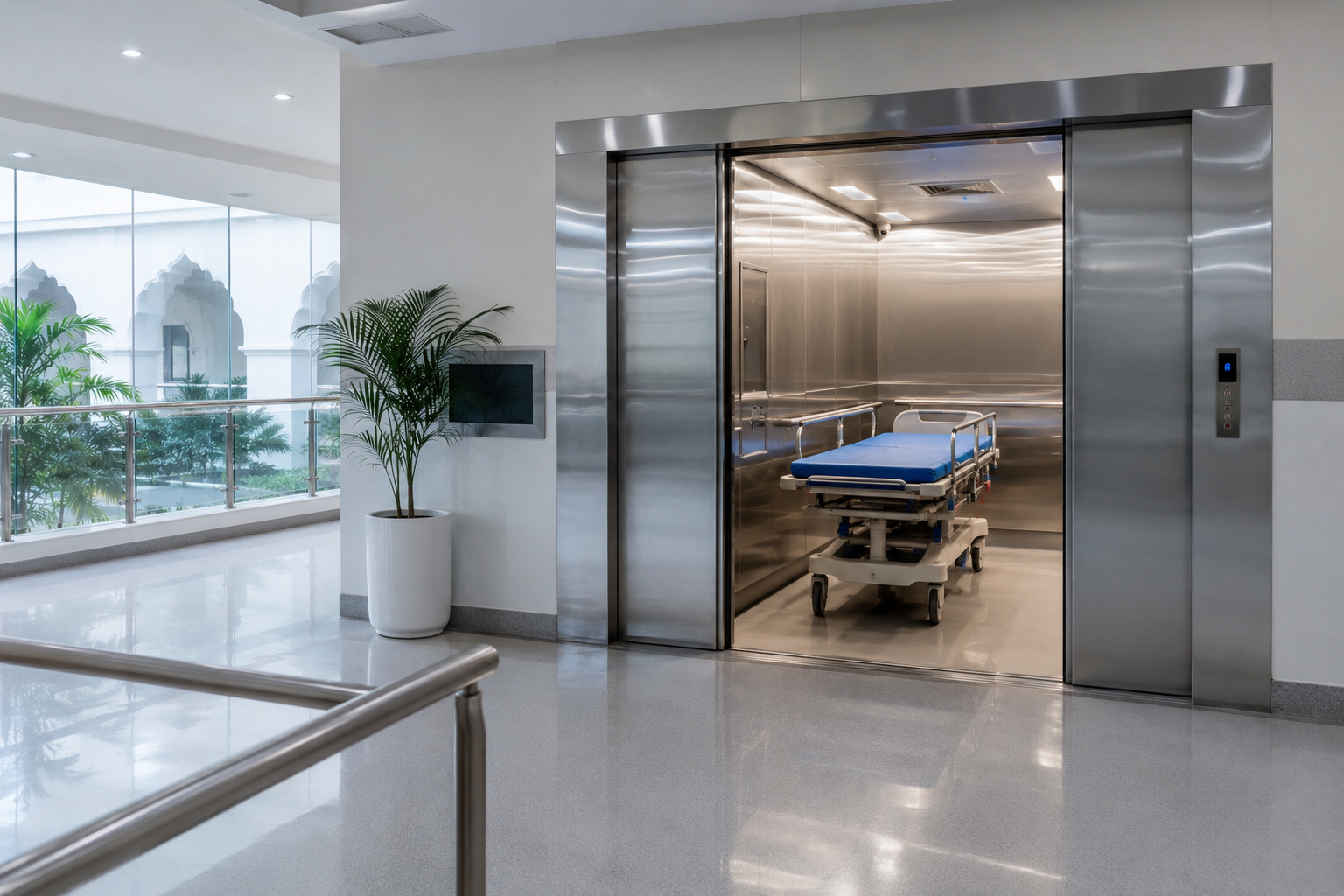
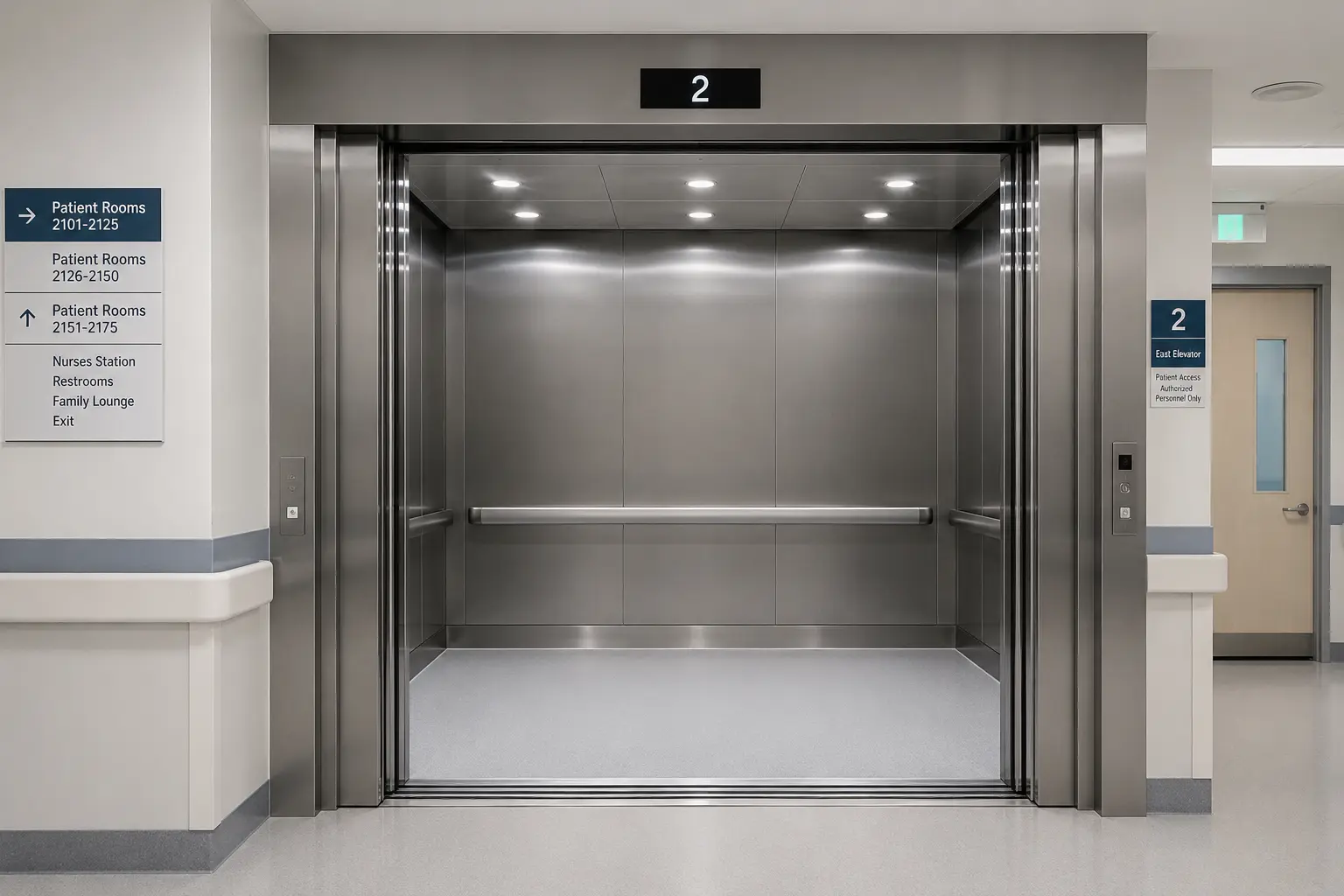
A hospital lift — often called a bed or stretcher lift — is a passenger elevator with a deep, large car and wide doors, sized to take a hospital bed or trolley together with the attendants and equipment that move with the patient. Beyond size, it is built for a smooth, precisely levelled ride, easy-to-clean hygienic surfaces and the kind of reliability a building cannot do without. The priority is the patient, not just the journey.
Bed / stretcher
deep car for a bed plus the care team
Wide doors
beds and trolleys roll straight in
Smooth & level
gentle ride, accurate floor stops
Hygienic
easy-clean, antibacterial finishes
Where a hospital lift is needed
Hospitals & multi-speciality
Moving patients between wards, theatres, ICUs and diagnostics — often urgently, and never stopping for the night.
Clinics & diagnostics
Day-care, imaging and outpatient floors where wheelchairs, trolleys and patients need a calm, dependable ride.
Care & elder homes
Residents with limited mobility, wheelchairs and assistance — comfort, accessibility and reliability come first.
Size it around the bed, not the people. The car has to hold a full hospital bed plus the attendants pushing it and the equipment travelling with the patient — with room to manoeuvre. That single requirement drives the car and door dimensions more than headcount ever does.
Plan these things early
- Car size for the whole picture — bed, care team and equipment, with space to move.
- Door width wide enough for beds and trolleys to enter straight, without angling.
- Smooth, accurate levelling so transfers are gentle and trolleys never catch on a step.
- Hygienic, easy-clean finishes that stand up to repeated cleaning and infection control.
- Backup power and reliability — a hospital lift cannot simply stop when the supply does.
- Fast service response written into the contract, because downtime here is critical.
The car, sized for care
Everything about a hospital car follows from one fact: a patient may be lying down and unable to move themselves. The car is deep, the doors are wide, and the ride is engineered to be gentle and exact — so a transfer feels safe for the patient and easy for the team.
Deep car
Takes a full bed plus attendants and equipment.
Wide doors
Telescopic openings beds roll through easily.
Gentle ride
Smooth motion and accurate, level stops.
Hygiene and a calm environment
In healthcare the cabin is also a clinical surface. Stainless steel and antibacterial panels, coved or sealed joints that do not trap dirt, a durable easy-clean floor, sturdy handrails and soft, even lighting all matter — both for infection control and for keeping an anxious patient calm. The finish is chosen to be cleaned hard, repeatedly, without looking worn.
The technology, in plain language
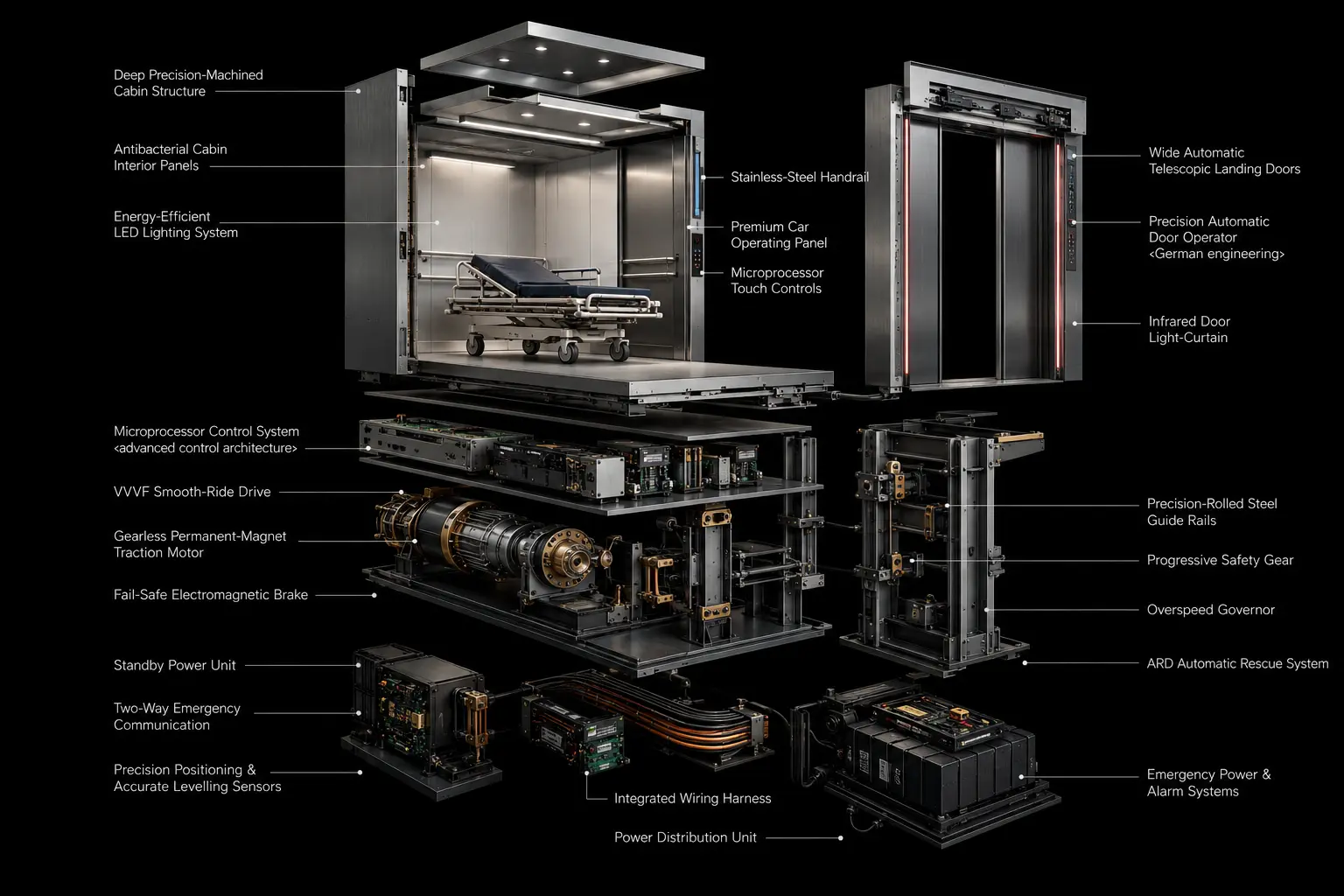
Smooth drive
Gearless traction with a VVVF drive gives the gentle motion and accurate levelling that patient transfers need.
Backup & priority
An automatic rescue device, standby power and emergency or priority operation keep a critical lift moving when it matters.
Monitoring
Remote monitoring spots faults early, so a hospital lift is serviced before it ever becomes a problem mid-shift.
Uptime is clinical, not optional. In a hospital, a stranded lift can delay a transfer that cannot wait. Backup power, fast service response and remote monitoring are not extras here — they are part of keeping the building safe to operate.
Mistakes we see in healthcare projects
- Undersizing the car, so a bed will not fit once the care team is inside.
- Doors too narrow for a bed or trolley to enter without a struggle.
- Poor levelling, so every transfer jolts the patient at the threshold.
- Finishes that cannot be cleaned hard enough for an infection-control setting.
- No backup power for a lift the hospital genuinely cannot lose.
- A slow service contract, where a breakdown means hours out of action.
Common questions
How big does the car need to be?
Large enough for a hospital bed plus the attendants and equipment moving with the patient, with room to manoeuvre. The bed, not the headcount, sets the car and door size.
Why does levelling matter so much?
If the car stops even slightly above or below the floor, a trolley or bed jolts at the threshold — uncomfortable for a patient and awkward for staff. Accurate levelling makes every transfer smooth.
How is hygiene and infection control handled?
Through antibacterial, easy-clean surfaces and sealed joints that do not trap dirt, so the cabin can be cleaned thoroughly and repeatedly as part of the facility’s infection-control routine.
What happens if the power fails?
An automatic rescue device brings the car to the nearest floor and opens the doors, and standby power keeps critical lifts running so a patient is never stranded between floors.
How is reliability assured?
With preventive maintenance, remote monitoring and a fast service response built into the contract — and, where the building needs it, more than one lift so care never depends on a single car.
Can an existing building get a hospital lift?
Often yes, where the shaft or available space allows the required car and door sizes. A site survey confirms what is achievable and what would need to change.
In a hospital, size the lift around the patient on the bed and the team around them, make the ride gentle and exact, and treat uptime as part of care. Everything else about the specification follows from that.
BRS Mobility Desk — Lucknow
How BRS approaches a hospital lift
BRS Elevator is a vertical-mobility solutions and service company based in Lucknow, working across healthcare, commercial and residential buildings. For hospitals and care homes we help you size the car and doors around real patient movement, specify smooth levelling and hygienic finishes, source and install the lift, and maintain it with the responsive service critical settings demand. We are not a manufacturer — we are the partner responsible for keeping your building moving.
Planning a hospital, clinic or care home?
Tell us about your facility — the floors served, the beds and equipment that move, and your reliability needs. We will help you size the car and doors, specify hygiene and backup power, and set up service that responds fast.
Reach BRS directly
Serving Lucknow and across Uttar Pradesh.