
Freight & Goods Mobility
A goods lift is sized by the heaviest, busiest day — not the average one.
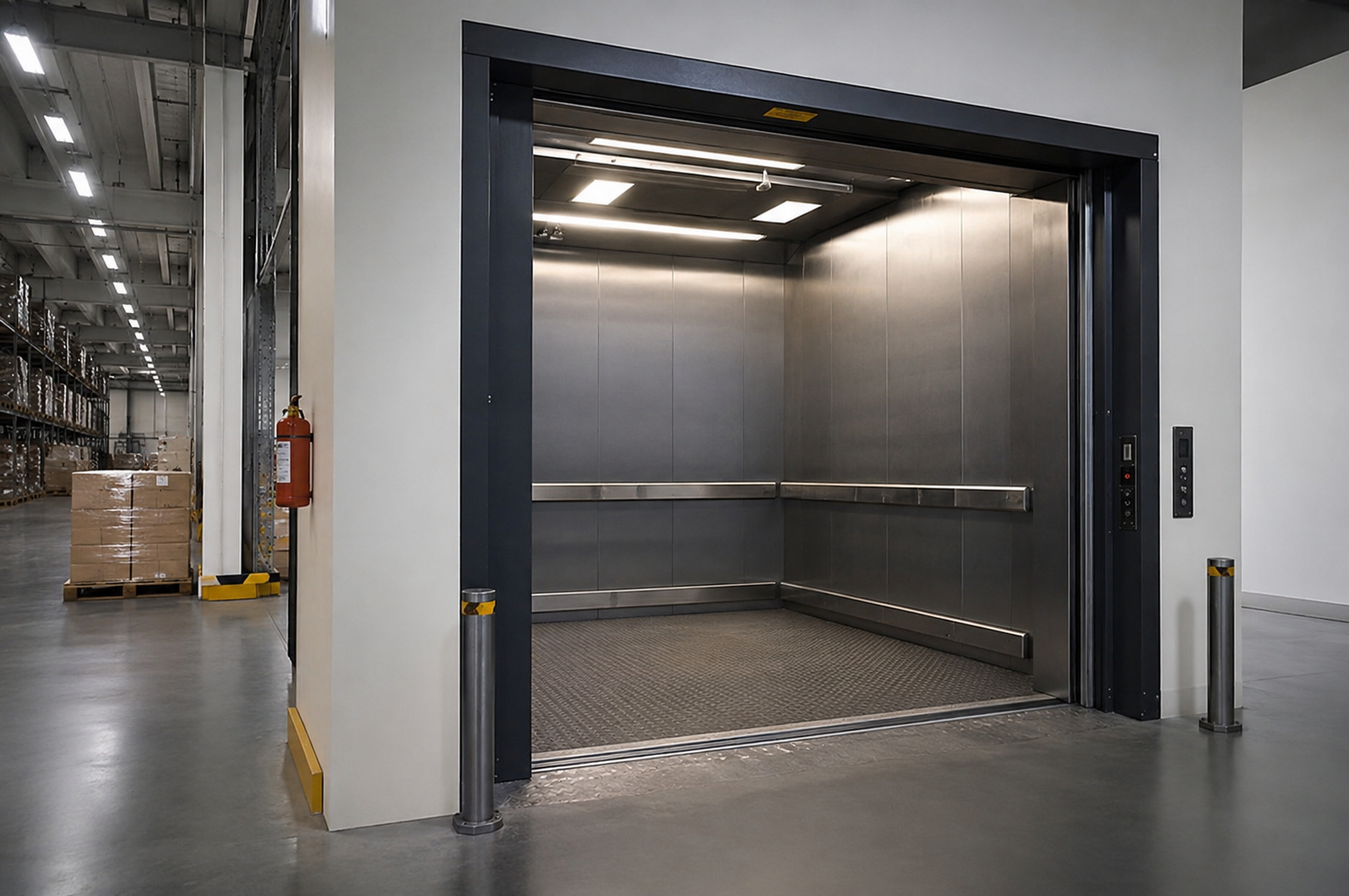
In a warehouse, factory or retail building, the goods lift moves stock, pallets and equipment all day. Get the load, platform and duty cycle right and it disappears into the operation; get them wrong and it becomes the bottleneck everything waits on. Here is how to specify one properly for a site in Lucknow or across Uttar Pradesh.
What a freight / goods elevator is
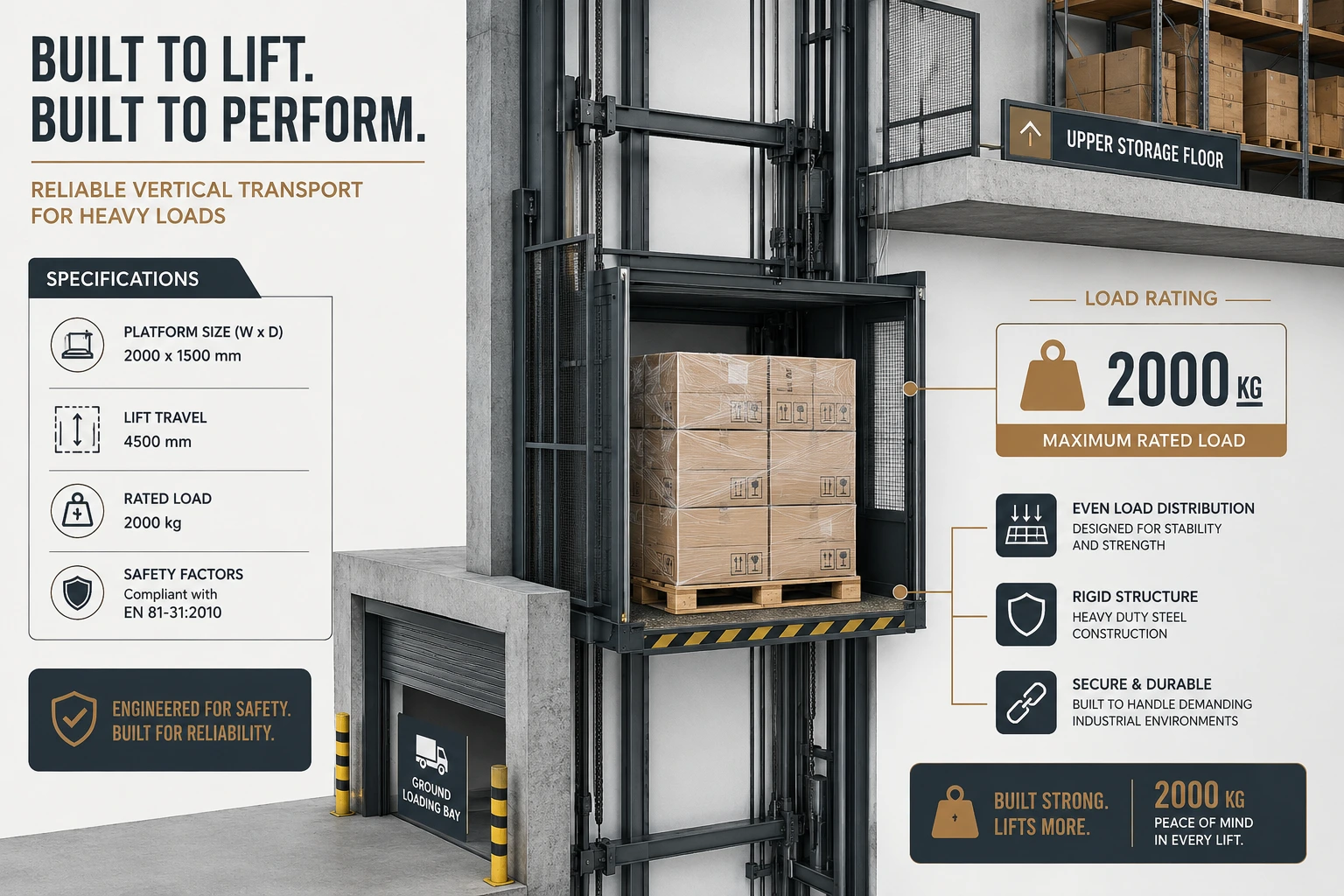
A goods elevator is built around load and repetition rather than comfort. It uses a larger, stronger platform, heavy-duty doors or gates, a robust drive and protective fittings so it can carry pallets, trolleys, equipment or stock — many times a day, for years — without wearing out. The right specification starts with what you move and how often, not with the cabin.
500–5000+ kg
capacities from light goods to heavy loads
Large platform
sized to pallets, trolleys or equipment
Heavy-duty doors
wide openings for easy, level loading
Built for cycles
engineered for frequent daily use
Where a goods lift fits
Warehouses & logistics
Pallets and stock between floors all day. Capacity and cycle time decide whether dispatch keeps up or backs up.
Factories & manufacturing
Raw material, work-in-progress and finished goods, often heavy and awkward. Build and protection matter as much as load.
Retail & hotel back-of-house
Stock, kitchen supplies and service trolleys kept off the customer-facing lifts and away from guests.
Capacity is not the only number that matters. Two lifts can both be rated for 2000 kg, yet only one is built for the duty cycle of constant loading. Frequency of use is what decides how long a goods lift actually lasts.
Specify these things up front
- Load and what carries it. Pallets, trolleys, drums or a stacker each change the size and rating.
- Platform size. The deck must take the largest item plus the equipment moving it.
- Door or gate type and width — wide enough to load straight in, without manhandling.
- Accurate floor levelling so trolleys and jacks roll on and off without a lip.
- Power and duty cycle matched to how often it runs, not just the peak load.
- Protection and service — bumpers, overload control and a maintenance plan from day one.
Loading & access
How goods get on and off the platform is as important as how much it carries. The platform, the door type and the floor levelling work together — if any one is wrong, every load costs extra effort and time.
Platform
Sized to the largest load plus the trolley or jack moving it.
Doors & gates
Bi-parting, roll-up or collapsible, chosen for the opening and use.
Level loading
Accurate stopping so wheels roll across without a step.
Built to take punishment
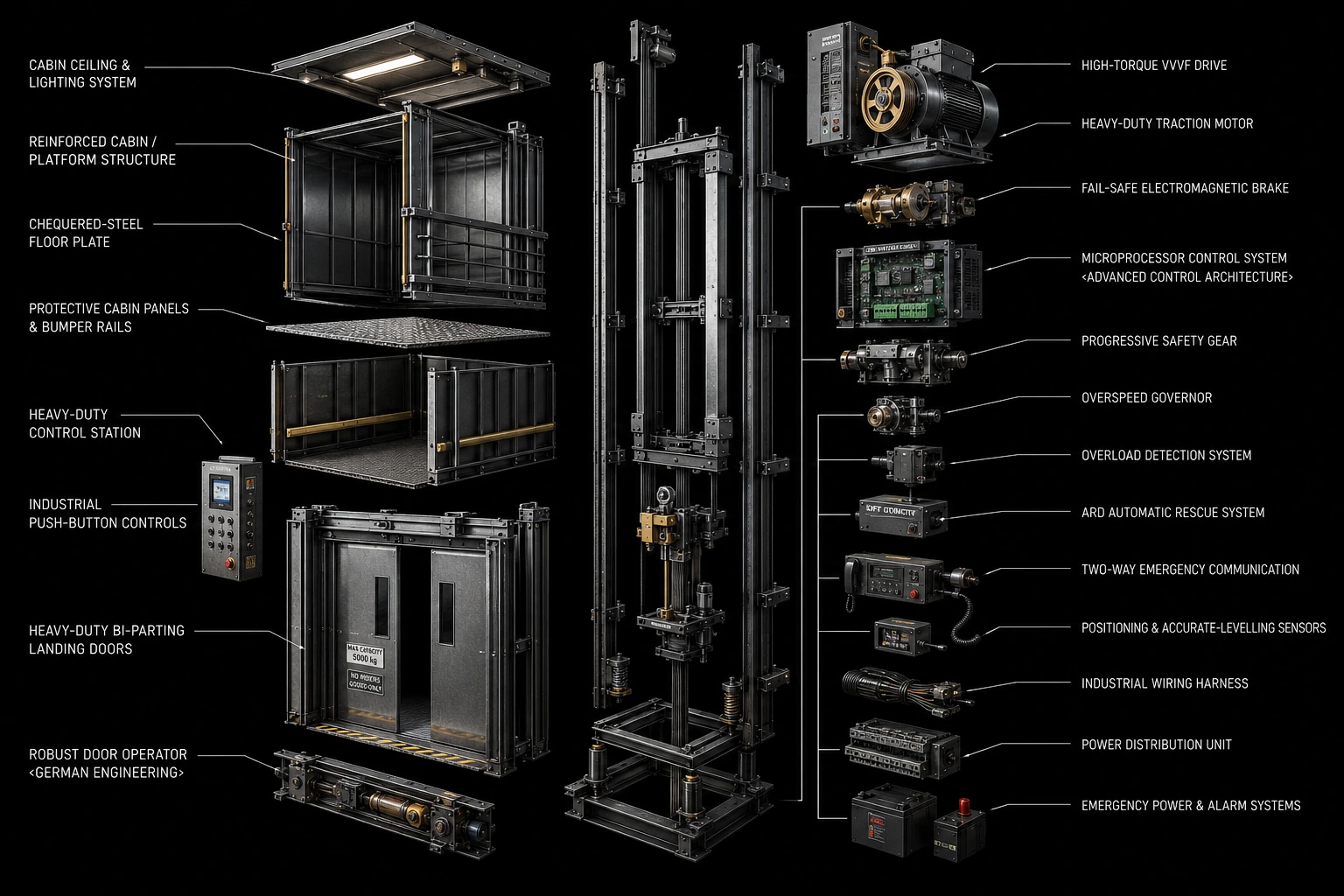
A goods lift earns its life from how it is built. A chequered-steel or reinforced floor, protective bumper rails inside the car, tough wall panels and a robust drive let it absorb knocks from pallets and trolleys without quickly looking and working like a tired machine. Durability here is not a finish — it is the specification.
The technology, in plain language
Drive for the load
Hydraulic drives suit heavy loads over a few floors; geared and gearless traction suit higher travel and frequent cycles.
Overload & safety
Overload detection, robust interlocks and clear load limits stop the lift being pushed past what it is rated to carry.
Door & gate systems
Manual or powered gates and doors matched to the opening, with interlocks so the lift only moves when it is safe.
Match the lift to the duty cycle. The fastest way to wear out a goods lift is to run it far more often than it was rated for. Tell the supplier how many trips a day it will really do — the honest number, not the brochure number.
Mistakes we see with goods lifts
- Undersizing capacity to save cost, then never being able to carry the real load.
- Ignoring duty cycle, so a lift rated for occasional use is run constantly.
- Choosing the wrong door or gate, making every load slow and awkward.
- Forgetting level loading, so trolleys catch on a step at every floor.
- Letting people ride a goods-only lift it was never approved to carry.
- Skipping in-car protection, so the cabin is battered within months.
Common questions
How much can a goods lift carry?
Capacities commonly run from a few hundred kilograms up to several tonnes. The right rating comes from your heaviest regular load plus the equipment that moves it, with a safety margin.
Can people ride in it?
Only if it is specified and approved for that. A goods-only lift is not for passengers; where people must accompany loads, a goods-cum-passenger type with the right safety features is specified instead.
What loading types can it handle?
Pallets, trolleys, cages, drums or stackers — each one influences the platform size, door width and floor levelling, which is why the load type is settled first.
How fast does it need to be?
Goods lifts are usually slower than passenger lifts by design — steady and strong matters more than fast. Cycle time across a few floors is what affects throughput, not top speed.
What about power and installation?
Heavier lifts generally need a three-phase supply. The exact requirement, pit and headroom are confirmed in the survey and built into the planning so installation runs to schedule.
How much maintenance does heavy use need?
More frequent than a lightly used passenger lift, because it works harder. A maintenance plan matched to the duty cycle is what keeps a hard-working goods lift dependable.
With a goods lift, tell us the truth about the heaviest load and the busiest hour. A lift specified for the real workload quietly does its job for years; one specified for the brochure becomes the thing the whole floor waits on.
BRS Mobility Desk — Lucknow
How BRS approaches a goods lift
BRS Elevator is a vertical-mobility solutions and service company based in Lucknow, working across commercial, industrial and residential buildings. For goods lifts we help you specify the load, platform and duty cycle correctly, source the right equipment, install it, and maintain it for the workload it actually carries. We are not a manufacturer — we are the partner responsible for keeping your operation moving.
Need a goods lift specified properly?
Tell us what you move, how heavy it is, and how often. We will help you size the platform, load and duty cycle, pick the right doors, and set up service that keeps it running through the busy days.
Reach BRS directly
Serving Lucknow and across Uttar Pradesh.