

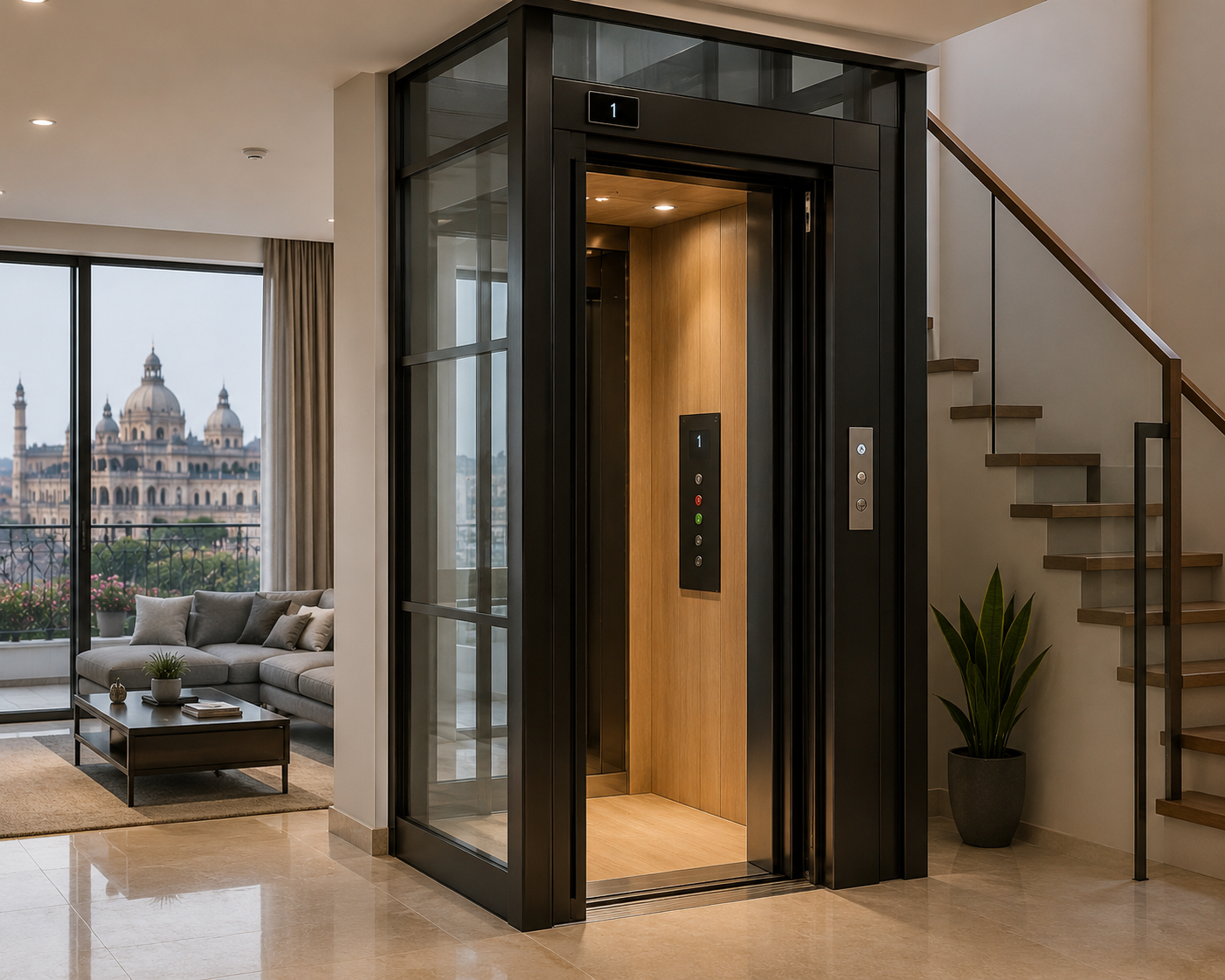
Residential Vertical Mobility
A home lift is no longer a luxury. It is how a modern multi-floor home stays usable for everyone living in it.
For villas, duplexes and independent homes across Lucknow and Uttar Pradesh, a residential lift quietly removes the one friction every multi-storey home eventually meets — the staircase. Here is everything worth knowing before you plan one.

What a residential home lift actually is
A home lift is a compact, low-speed passenger lift engineered specifically for private homes — typically carrying 2 to 6 people across 2 to 5 floors at a gentle 0.15–0.3 m/s. Unlike a commercial lift, it is designed to fit into a home’s structure, often runs on ordinary single-phase power, and is quiet enough to sit beside a bedroom. It is closer to built-in home infrastructure than to industrial machinery.
2–6
persons per ride (about 180–400 kg)
2–5
floors served in a typical home
Whisper-quiet
0.15–0.3 m/s, gentle and smooth
~1.0 × 1.0 m
smallest footprint, fits tight homes
Where a home lift fits in your house
New construction
Plan the shaft along with the building. This is the cleanest and most cost-effective route — the lift becomes part of the architecture rather than an addition to it.
Retrofit in an existing home
A self-supporting lift can be added to a home that is already built — no concrete shaft required. It is commonly placed in the stairwell void, a corner of the home, or against an external wall.
Around the staircase or courtyard
Wrapped by the staircase or set in a courtyard, a glass cabin becomes a design feature — movement you can see, rather than a box hidden away.
Key point most people miss: you do not need a concrete lift shaft. A modern home lift can stand on its own self-supporting structure — which is exactly why it can be added to homes that are already finished.
Plan these six things early
- Decide during design, not after. Retrofitting later costs more and narrows your choices.
- Floors and door openings. Confirm which floors are served and where the door opens on each.
- Power. Single-phase is enough for many home lifts; confirm the supply and plan battery backup.
- Door type. Automatic doors are safer and easier for children and elderly users than manual swing doors.
- Who uses it in ten years. Aging parents or a wheelchair change the size and door brief entirely.
- Service from day one. Know who maintains it and how quickly they respond before you buy.
How much space does it really need?
Older lifts demanded a deep concrete pit and a machine room on the roof. Modern home lifts need far less. Many run on a shallow pit and house the drive inside the shaft itself, so no separate machine room is required — which is what makes them realistic for ordinary homes.
Shallow pit
Reduced-pit models need only a small recess instead of a deep concrete pit.
No machine room
Machine-room-less designs keep the drive inside the shaft, saving roof space.
Compact shaft
A 2-person cabin can fit in roughly a 1.0 × 1.0 m footprint.
It can look like part of the house — not an afterthought
A home lift is now a finishing element, not a utility box. Cabins come in glass, mirror, brushed steel, wood and textured laminate; shafts can be fully glazed for a panoramic effect; landing doors can sit flush with the wall; and integrated lighting lets the lift match the rest of your interior. Chosen well, it reads as architecture — the same way a good staircase does.
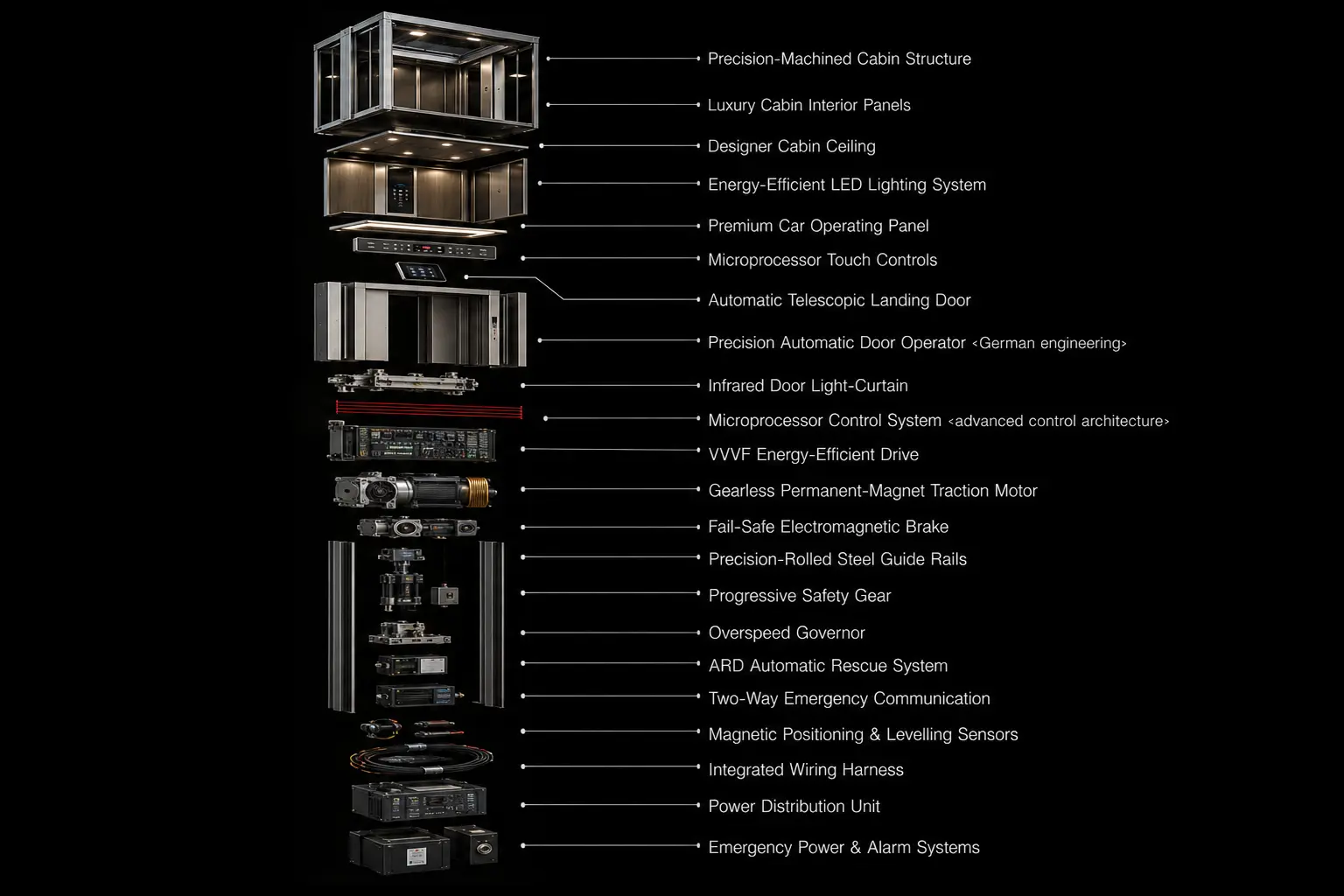
The technology, in plain language
Gearless traction
Quiet, smooth and energy-efficient with low maintenance. The common modern choice for homes that want comfort and low running cost.
Hydraulic
Very smooth and strong, good for heavier loads. Uses more energy and needs more upkeep, so it suits specific cases rather than every home.
Screw / nut drive
Mechanically simple and very safe, though slower. A practical fit for compact homes and shorter travel.
Safety, non-negotiable. Every home lift should include an Automatic Rescue Device — which brings the cabin to the nearest floor and opens the doors during a power cut — along with door sensors, overload protection, an emergency alarm, and battery backup.
Mistakes we see homeowners make
- Deciding on the lift only after construction is finished.
- Choosing manual doors to save money, then regretting it with elderly users.
- Sizing for today instead of for wheelchairs or aging parents later.
- Comparing only the price, ignoring who services the lift and how fast they respond.
- Skipping power backup, then losing the lift on every outage.
- Treating the lift as machinery instead of as part of the home.
Common questions
What happens during a power cut?
With an Automatic Rescue Device and battery backup, the cabin moves to the nearest floor and opens its doors automatically. You are not left stranded between floors.
Is it safe for children?
Yes. Door sensors, no exposed machinery, automatic doors and simple controls make it safe for everyday family use. As with any door at home, young children should still be supervised.
Can elderly or wheelchair users use it comfortably?
Yes, when it is planned for that — automatic doors, a level landing, a grab rail and a cabin sized to take a wheelchair. This is exactly why the brief should look ten years ahead.
Can an existing home get a lift?
Usually yes. A self-supporting lift can be added without breaking the structure for a concrete shaft, often in the stairwell void or against an outer wall.
Will it spoil the look of my home?
It can improve it. Glass cabins and flush landing doors are now treated as a design feature rather than something to hide.
How much maintenance does it need, and is it costly to run?
Periodic servicing under an annual maintenance contract; gearless lifts are low-maintenance. A modern home lift draws roughly the power of a household appliance per ride. What matters most is how quickly your provider reaches you when you need them.
Most families do not regret installing a home lift. They regret waiting until a parent struggled on the stairs to think about it. Plan it once, while you build, and the house stays comfortable for the next thirty years.
BRS Mobility Desk — Lucknow
How BRS approaches a home lift
BRS Elevator is a vertical-mobility solutions and service company based in Lucknow, working across both homes and commercial buildings. We do not push a single product. We help you choose, source, install, modernise and maintain the right lift for your home — and we stay responsible for it afterwards. Our promise is clarity: honest advice, transparent planning, and service you can actually reach when it matters.
Thinking about a home lift?
Tell us about your home — how many floors, who will use it, and whether it is being built or already standing. We will walk you through what fits, what it needs, and what to plan for. No pressure, no jargon.
Reach BRS directly
Serving Lucknow and across Uttar Pradesh.