

The lift is one of the few elements of a building that the architect cannot fully design without specialist input. It is also one of the few elements that, when it goes wrong, cannot be quietly hidden behind a wall and forgotten. A poorly-placed shaft, an under-spec’d headroom, an unbuildable pit — each of these costs the project months, money, or both, often after the slab has been poured.
This document is the brief we wish every architect we work with had on their desk before the shaft is drawn. We have written it for new construction; the same questions apply to retrofits with slight modifications.
This is the question that determines every other answer. Daily passenger commuting, household movement, goods, hospital stretchers, vehicles, food service in a hotel — each use case rewrites the brief. A six-person passenger lift, a 1600-kilogram stretcher lift, and a 2500-kilogram service lift are not variations of the same building element. They are different lifts with different shafts.
The brief should name the primary use case in one sentence and any meaningful secondary use cases in a second. The lift will then be specified backward from those sentences. We do not start with capacity; we start with use case and arrive at capacity.
The right way to design a passenger lift is from the harder-case user backward. In a residential building, the harder-case user is the elderly resident with reduced mobility, possibly using a wheelchair or a walker. In a commercial building, it is the delivery worker with a loaded trolley. In a hospital, it is the stretcher with attendants and equipment. In a hotel, it is the housekeeping cart followed thirty seconds later by a guest in evening wear.
The lift that works for the harder-case user works for everyone. The lift that is optimised for the average user, with the harder-case user as an afterthought, eventually fails the people who needed it most. This is a planning principle, not a sentimentality.
The shaft has to be straight, plumb, and uniform in dimensions from the lowest point to the highest. This sounds obvious. It is, in practice, the single most common source of last-minute drama on a project.
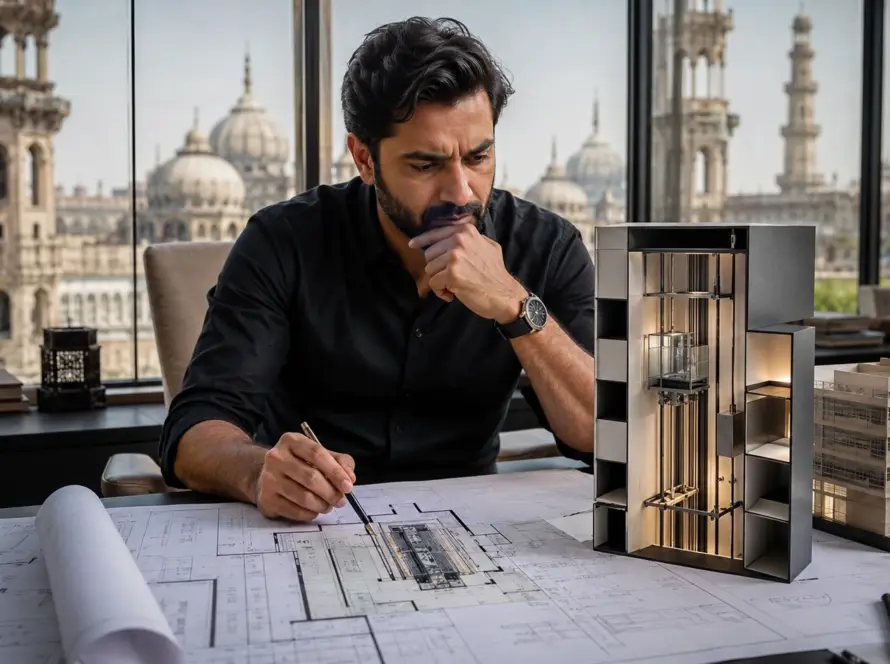
Before the structural drawings are finalised, stack the floor plans of every level the lift will serve. Trace the shaft footprint at every floor. If a column edges into the shaft at one level, or a beam runs across the shaft at another, the lift does not fit. We have walked into projects where the lift, as drawn, would have collided with a column at the second floor and a beam at the third. Both were structural elements. Neither could be moved.
The fix is to stack-check the shaft on paper before the structural team locks in the slab layout. It costs one careful afternoon. The alternative costs months.
This decision deserves to be made early, because it affects the terrace design, the roof structure, the waterproofing strategy, and sometimes the façade. For most low-rise and mid-rise residential and small commercial projects, MRL is now the default; the machine room is deleted from the brief. For higher-rise projects, projects with very heavy loads, or projects where the machine-room solution is structurally cleaner, conventional traction with a roof-top machine room is still the right answer.
The decision should not be deferred to “we’ll see what fits later.” It should be made consciously, at the schematic-design stage, after a conversation with us about the specific building. Once the slab and the roof have been designed against one of the two options, switching to the other is expensive.
The headroom — the vertical distance from the topmost finished floor to the underside of the shaft roof — is the dimension that gets squeezed late in the project, usually by the structural team trying to keep the building’s height down. Squeezing it by 100 millimetres makes some lifts unbuildable.
The architect should obtain the headroom requirement from us, in writing, against the specific lift specification, before the topmost slab is dimensioned. The required headroom is a function of the lift system and the rated speed. For a typical residential MRL at 1.0 metre per second, the figure is 2.7 metres. For a heavier passenger lift at 1.6 metres per second, the figure is 3.6 metres. The architect should not assume; they should ask.
The pit is the depth of the shaft below the lowest landing. The required depth depends on the lift system and speed; for most residential and small commercial lifts it is between 1.0 and 1.5 metres. The pit needs to be dry, year-round.
In Lucknow, the water table sits seasonally close to the surface in several localities — Indira Nagar, parts of older Gomti Nagar, Aliganj near the canals, much of the older trans-Gomti area. A 1.5-metre pit in these areas will fill with groundwater during the monsoon unless it is specifically engineered as a waterproofed concrete tank with provisions for an automatic sump pump. The architect should obtain the water-table depth from the site geotechnical report, share it with us at the design stage, and we will specify the pit construction accordingly. The cost of doing this at design stage is moderate. The cost of discovering the problem in July of year one is severe.
Confirm three-phase availability if the lift specification requires it, voltage stability across the day, the inrush current allowance from the local utility supply, and the building’s DG capacity if the lift is to be on backup. The lift does not strictly need to be on the DG for safety — the ARD handles passenger rescue on its own backup battery — but for daily building operations, it usually should be. A multi-floor commercial building whose lift stops working every time the mains fails is operationally crippled. The DG sizing has to include the lift’s starting current with margin.
How does the cabin door open, and onto what? Door type, door width, threshold height, lobby width at each floor, fire compartmentalisation, finish material adjacent to the door frame, lighting at the landing, accessibility clearances on both sides — all of these are nicer to coordinate at the schematic stage than at fit-out.
A specific note on fire: in buildings above 15 metres in height, the lift’s fire-mode behaviour is a code-compliance item, not a convenience feature. The architect’s project documentation must include fire-mode specifications and the corresponding modifications to the lift’s controller programming. This is something we coordinate; the architect should know to ask for it.
How does a technician reach the controller, the brake, the drive unit? For a conventional traction lift, the answer is through the machine-room door. For an MRL, the answer is from the topmost landing — there is no separate room — but the topmost landing must allow safe technician access to the shaft top. In poorly-designed installations, this access route runs through somebody’s living room or a private corridor; in well-designed ones, it runs through a service corridor with its own door.
The lift will be serviced monthly for thirty years. Designing the access route consciously, once, is the right answer.
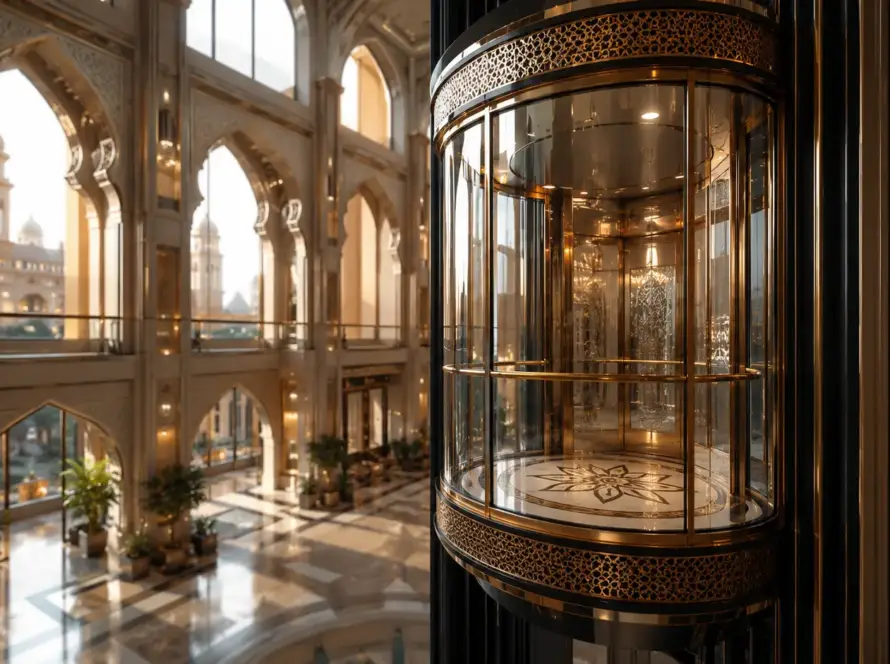
This is the question architects do best. What does the lift want to be inside this specific building? A piece of background infrastructure that the building reveals only on use, or a deliberate architectural element that the building wears proudly? Both are valid answers. The decision should be made consciously and conveyed to us in the brief.
We can usually do more than catalogues suggest. Bespoke cabin interiors, glass shafts integrated with the building’s atrium, designed control panels that match the rest of the building’s hardware — these are available, with lead time, at a cost premium. We can also do less than reference images sometimes demand: certain elements, particularly fully unframed glass cabins or specific exotic-material finishes, are not buildable to Indian safety code at residential scales. The honest conversation about what is and is not possible is one we are happy to have, in writing, at the design stage.
If a project of yours is at the design stage right now, the most useful thing we can do for the architecture is one meeting, at the schematic-development stage, of about an hour, with the architect and the structural engineer in the same room. We answer questions 1 through 10. The architect leaves with the lift’s full envelope specification — shaft dimensions, headroom, pit, structural loads, power supply, service access — in writing.
This is, by some distance, the cheapest, most useful hour in the entire project. We do not charge for it. We do not expect a commitment in return. The project is better for the conversation regardless of who eventually supplies the lift.