

For most of the time elevators have existed inside Indian homes, the lift cabin has been a functional object. It got you from one floor to another. Its interior was specified to be cleanable and durable, in roughly that order. The stainless-steel walls, the chequer-plate floor, the cool-white tube light overhead, the small mirror in one corner — these were the working defaults, and they were the working defaults for the same reason every commercial lift had them: they were robust, they were cheap, and the building’s owner was buying a piece of equipment rather than a piece of the building.
That logic still applies in a hospital, in a goods lift, in a back-of-house service installation. It does not apply, anymore, in a home.
The cabin of a home lift is a small room. It is roughly a metre by a metre and a half on the inside. It has four walls, a ceiling, a floor, two doors, and lighting. Every member of the household enters it, alone or in twos, several times a day. They look at the same surfaces. They touch the same surfaces. They are inside the same volume of air, inside the same arrangement of materials, for ten to thirty seconds, several times a day, for the next thirty years.
This adds up to thousands of small in-cabin moments per household per year. A modest household using a lift twenty times a day spends, in aggregate, roughly thirty hours a year inside the cabin. Across thirty years of the lift’s working life, this is close to a thousand hours of cumulative occupancy per household. A thousand hours is more time than the household will spend in many of the home’s other rooms — the guest bedroom, the formal sitting room, the third-floor study used only by one member. The cabin is, by this measure, one of the more occupied rooms in the house.
It is also, in most homes, the room whose materials have been chosen with the least care.
The default residential cabin specification, still offered by most providers, is a hairline-finish stainless-steel wall on all four sides, a chequer-plate stainless-steel floor, a flat acrylic ceiling panel with a recessed cool-white LED fixture, and a small mirror on the rear wall. The doors are stainless steel. The handrail, if specified, is a stainless-steel tube.
This specification is functionally adequate. It is also visually unrelated to almost any home it gets installed in. The household has chosen wood, stone, or earth tones for its floors. It has chosen warm-toned lighting throughout the rest of the house. It has chosen specific textures for the walls — paint, panelling, wallpaper. And then the lift cabin, opening directly onto these surfaces, is stainless steel and cool white. The cabin reads as foreign infrastructure inserted into a residential space, because that is exactly what it is.
The household experiences this every day for thirty years. Most of them stop seeing it consciously after a few months. The cabin has been mentally filed as “the lift” — the same category they encountered in office buildings — and the sense that the cabin could have been part of the house, rather than alongside it, has slipped out of consideration.
The cabin specification has four meaningful design decisions. Each can be made consciously rather than defaulted to, at a cost premium that is modest in absolute terms and almost trivial in proportion to the lift’s total cost.
The cabin floor is the single element that most affects how the lift feels underfoot. Stainless-steel chequer plate is cold to bare feet, loud underfoot, and aggressively industrial in appearance. The alternatives are not exotic. A natural-stone floor — granite, marble, kota, or quartz — laid as a single sealed surface, matches the floor of the landings that the cabin opens onto. An engineered-wood floor, sealed against moisture, is appropriate in a home where the rest of the home’s flooring is also wood. A large-format matt-finish ceramic or porcelain tile, in a tone that complements the home’s overall palette, is the third common answer.
The structural specification of the cabin floor accommodates all of these without modification. The cost difference between the default and any of the alternatives, for a typical residential cabin, is between fifteen and forty thousand rupees. Spread across the lift’s working life, this is a small number for a daily experience improvement that the household will not consciously notice and will, equally, never want to go back from.
The cabin walls are the largest visible surface in the lift and the surface that most determines how the cabin reads as a space. The serious alternatives to default stainless steel fall into four categories.
Veneer panels. Sealed wood veneer over a fire-rated substrate, with a finish that matches or complements the home’s interior woodwork. Walnut, teak, oak, and ebonised options are common. Veneer is durable, repairable, and ages well. It is the right answer in most homes that have used wood as a primary material elsewhere.
Leather-clad panels. Stitched leather over a backing panel, in a single tone or a deliberate two-tone treatment. Leather is, surprisingly, both durable and forgiving — small scuffs from belt buckles or bag corners blend into the patina rather than showing as damage. The right choice for a home with a stronger luxury intent in its other rooms.
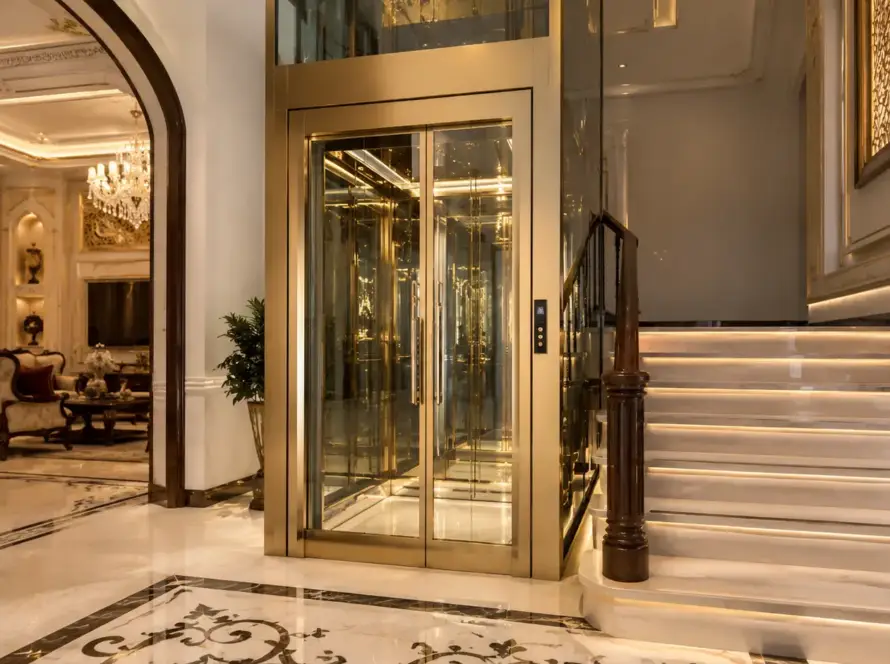
Brushed-metal panels. Brushed brass, brushed bronze, brushed champagne-gold, or hammered copper. These are stainless steel’s serious cousins. They retain the durability and cleanability of metal but introduce warmth, character, and a tone that integrates with the home’s hardware rather than fighting it.
Glass panels. Toughened laminated glass, sometimes onto a designed shaft enclosure that is itself part of the architectural composition. This is the most theatrical option and the one that requires the strongest collaboration with the home’s architect. Done well, the cabin disappears into the building’s vertical experience and the lift becomes the most photographed object in the house.
The cost premium over default stainless steel ranges from forty thousand for veneer to two lakh and beyond for fully customised glass-and-leather treatments. Even at the higher end, the premium is a small fraction of the lift’s total project cost.
Cabin lighting is the most under-considered specification, and it is the one that most affects how the cabin feels at the end of a long day. Default cool-white LED panels in the ceiling deliver functional illumination and not much else. The cabin reads as clinical, the occupants’ faces are not flattered, and the volume of air inside the cabin feels harder than it needs to.
The right specification, in a residential cabin, is warm white at roughly 3000 kelvin, delivered indirectly through a coved or recessed configuration, with a colour rendering index of at least 90. The cabin becomes a small interior space rather than a small piece of infrastructure. The change is dramatic. It is also nearly free — the lighting hardware costs between five and twenty-five thousand rupees more than the default, depending on the fixture chosen.
A small additional consideration: cabin lighting on a backup battery, with appropriate dimming for the unoccupied state, extends both the cabin’s daily feel and the lift’s effective service life by reducing fixture stress. We recommend it on every residential cabin we specify.
The cabin’s control panel, the indicator above the door, the handrail, and the small fixtures inside the cabin — these are the cabin’s hardware, and they are read by the household the way the hardware of a kitchen is read. The default catalogue button panel and digital indicator are visually unrelated to most homes. Bespoke or selected panels are available, with the same effort required to specify good kitchen hardware, in finishes that match the home’s other metal elements.
The handrail deserves specific mention. The default tubular stainless-steel handrail is functional. A designed handrail — in a finish that matches the cabin’s walls, with a profile shaped for actual hand grip rather than for ease of manufacture — costs a small premium and is touched by every member of the household every single ride.
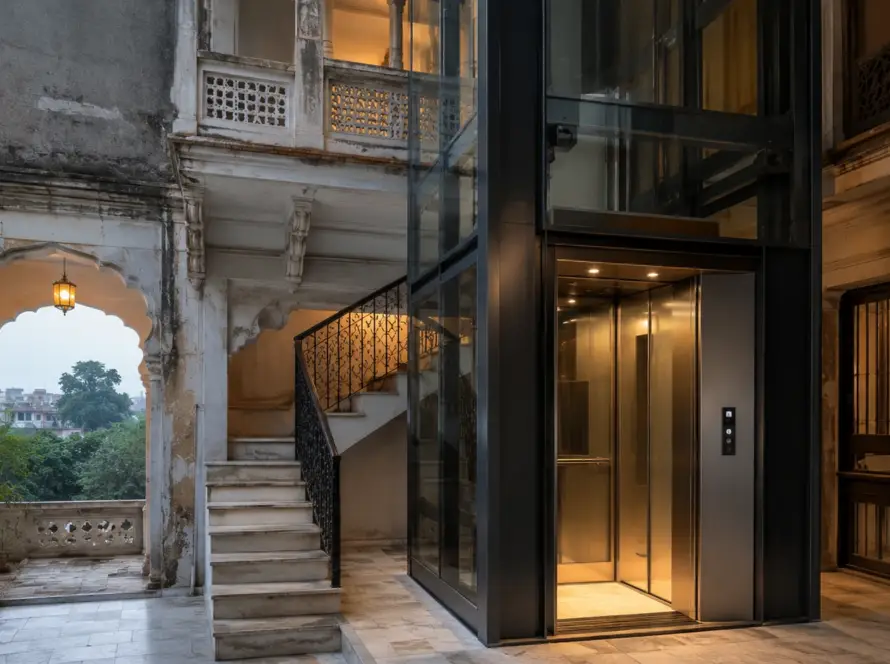
In a glass-shaft installation, the shaft itself becomes part of the lift’s visual experience. The shaft can be specified in materials that complement the cabin and the surrounding architecture. Powder-coated structural steel in a deliberately chosen colour. Brushed metal panels at the floor edges. Designed lighting that runs the length of the shaft. The cabin becomes the moving element inside a designed vertical space, rather than a moving object inside a concrete tube.
This level of integration requires the architect to be involved from the design stage. It is not retrofittable in any meaningful way. The household that wants this in a new home gets it as part of the building’s design. The household that wants it in an existing home usually has to settle for a less integrated version, which is often still meaningfully better than the default.
The total premium to specify a cabin properly, rather than defaulting to the catalogue, runs between sixty thousand rupees and three lakh, depending on the choices. The household’s total project cost for the lift, including civil works and electrical, is between fourteen and twenty-five lakh in the typical case.
The premium for the cabin is, therefore, between three and twelve percent of the total project cost. It is the line item that delivers the largest daily experience return per rupee of any decision in the entire project.
The household that specifies the kitchen carefully and defaults the cabin is making a strange allocation of attention. The kitchen will be renovated again in fifteen years. The cabin will not.
A home lift’s cabin is one of the most used rooms in the house. It deserves the same considered specification as the other rooms it opens onto. The decisions are not exotic. The premium is modest. The household will, every day for thirty years, step into a small room that feels like part of their home rather than alongside it.
If your home is at the stage of specifying a lift, the cabin design conversation is one we are happy to have with your architect or interior designer present. It takes an additional hour beyond the standard site visit. It produces a cabin the household is proud of for the lift’s full working life.