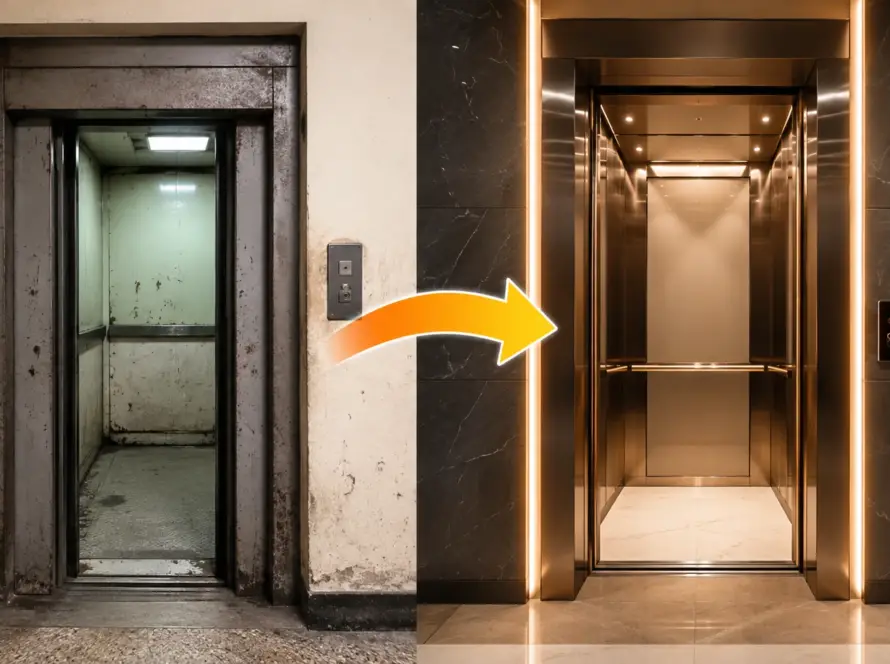


Lucknow’s older neighbourhoods are populated with buildings that were designed for a different relationship with the staircase. The havelis of Chowk and Aminabad. The 1970s and 1980s independent homes of Hazratganj and the older parts of Mahanagar. The deliberately-built family homes of Aliganj and Indira Nagar from the 1990s. These buildings were constructed at a time when an Indian family’s vertical ambition stopped at the second or third floor, the staircase was the obvious answer, and the lift was something that lived in commercial buildings downtown.
The families inside these buildings have changed. The buildings, in many cases, are still excellent. The combination has produced a category of conversation we have a lot of in Lucknow now: the lift retrofit into a building that was never designed for one.
The most common reason a household in an older Lucknow home does not pursue a lift is the assumption that the building cannot have one. The assumption is mostly inaccurate. Modern compact lift systems — particularly MRL configurations with reduced headroom and reduced pit depth — have been engineered specifically for the case of “the building was not designed around a shaft.” The question is no longer whether the building can have a lift. The question is where the lift should go and how cleanly it can be installed.
Across the retrofits we have done in older Lucknow buildings, the lift ends up in one of five recurring locations. The choice depends on the building’s specific layout, structural condition, and the household’s aesthetic preferences.
Inside the central staircase. Many older Lucknow homes have a generous central staircase with a usable visual hollow inside the curve. This space, often used only as a structural void or for hanging a chandelier, can sometimes accommodate a compact home lift shaft without disturbing the staircase itself. The result is striking: the lift becomes the visual centre of the staircase, the staircase wraps around it, and the house looks more deliberate than it was originally designed to.
Through a stacked column of utility rooms. Many older buildings have a vertical alignment of small bathrooms, store rooms, or wardrobes that line up floor by floor. If the alignment is structurally feasible — which it often is, because the original architect typically aligned these elements for plumbing reasons — the column can be reorganised into a lift shaft. The household loses one storage closet per floor, which is usually a fair trade.
Attached externally to the building’s rear or side. A steel-and-glass shaft is built outside the existing structure, with door openings cut into the exterior wall at each floor. This is the cleanest answer for buildings where no internal space is available. Done well — with the household’s architect involved from the start — the external shaft is the most architecturally interesting addition the building has ever received. Done badly, it looks like a lift was attached to a house. The difference between the two outcomes is the architect’s involvement at design stage.
Through a balcony stack. Many older Lucknow homes have small, underused balconies stacked above each other, often used only to hang one set of washing or to receive sunlight that is then immediately curtained off. If the balconies are aligned, they can be enclosed and converted into a shaft. The household loses one usable balcony per floor; it gains a lift.
Replacing a non-load-bearing wall. In some older homes — particularly those built in the 1990s with framed-structure construction rather than load-bearing walls — a vertical line of non-structural walls can be removed and the resulting void converted into a shaft. This is the most invasive option and requires the most careful structural analysis, but it produces the cleanest visual result inside the home.
Older buildings have personalities. The retrofit conversation has to respect them. Five technical areas deserve particular care.
The structural assessment. An older building’s foundation, columns, and beams were sized against a specific load profile. The lift adds a new load path that the original design did not anticipate. A structural engineer has to assess whether the existing foundations can take the additional load, whether the column system around the shaft is adequate, and whether any reinforcement is required. We do not start a retrofit without this assessment in writing.
The topmost-floor structure. Older buildings often have generous floor-to-ceiling heights, which is helpful for the lift’s topmost headroom requirement. But the terrace structure — the slab above the topmost floor — may not be sized to take the lift’s structural anchoring at the top. The assessment includes the terrace, not just the floors below it.
The pit and the water table. Lucknow’s water table sits seasonally close to the surface in several older localities. A standard lift pit, dug into an older home’s ground floor, will fill with groundwater during the monsoon unless it is specifically engineered as a waterproofed concrete tank with sump-pump provisions. The geotechnical conditions at the site have to be known before the pit is committed to.
The electrical capacity. An older building’s electrical service was sized for an era of fewer appliances and lower demand. Adding a lift typically requires an upgraded service connection from the supplier, an updated distribution board inside the home, and dedicated cabling to the shaft. The work is straightforward; it has to be planned for, not discovered late.
The heritage and façade considerations. Some older Lucknow homes have façades worth preserving. An external shaft can be designed in a material and finish that complements the façade — brushed steel framing, glass with bronze tinting, deliberate visual referencing to the building’s existing language — but only if the design intent is established at the start. A shaft designed without this consideration becomes a structural addition that the house wears badly.
A retrofit into an older home does not require the household to vacate. We routinely complete residential retrofits with the family living in the building, with the construction work contained to specific zones at specific times. The civil works — opening the shaft area, structural reinforcement, pit excavation — typically take two to four weeks. The lift installation, once the civil works are complete, takes another two to three weeks. The cabin finishing and commissioning take a final week.
The total disruption to the household’s daily life is real but contained. The elderly family member, who is often the person the lift is being installed for, is not displaced from the home during the work.
The homes that our parents and grandparents built in Lucknow were built well. Their staircases are honest. Their proportions are generous. Their materials are, in many cases, of a quality that newer construction does not match.
What these buildings deserve, as their original residents age into them, is the modest addition that returns full use of all their floors to all of their people. The lift is, in this sense, not a renovation of the building. It is a restoration of the original design intent — which was that every floor of the building should be available to every member of the family — under the new conditions of the family that now lives there.
If your home is one of these buildings and the conversation has begun to surface in your household, the site visit is the right starting point. The assessment is honest. The recommendation is specific. The retrofit, if pursued, is one of the better things that will happen to the building this decade.