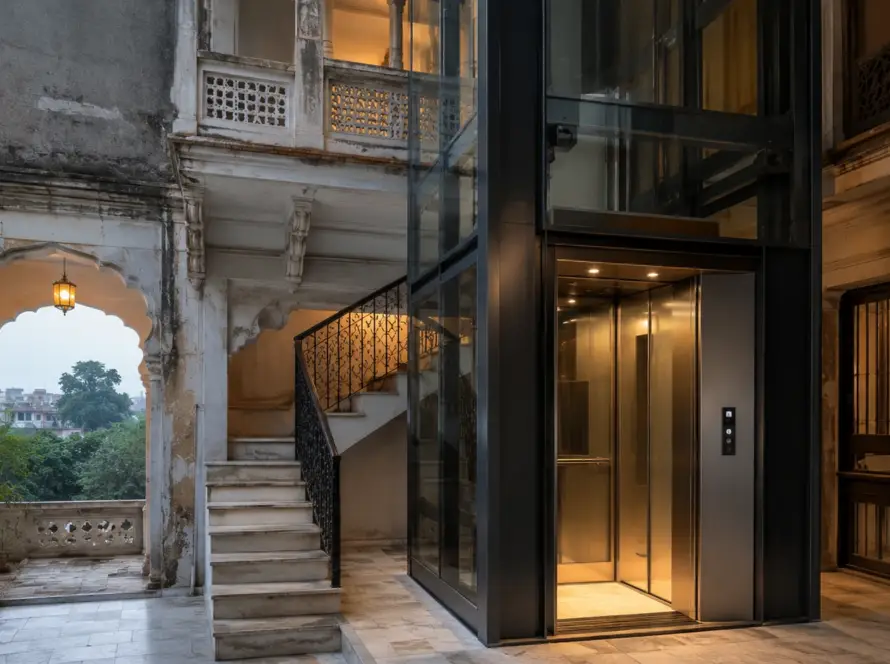


The resale question arrives in almost every home-lift conversation, but it usually arrives the wrong way around. The household asks whether the lift will “pay for itself” in resale value, the way a kitchen renovation supposedly does. The honest answer is that this is the wrong frame, and the right frame — which is more interesting — does not produce a single number but does produce a clear picture of how the lift affects the household’s eventual exit from the home, if and when that exit happens.
The mental model behind the question is roughly the kitchen-renovation model. You spend ten lakh on a modular kitchen. The home sells for ten lakh more than it would have without it. The renovation has “paid for itself.”
This is, even for kitchens, a rougher truth than it sounds. The kitchen does not show up as a separate line on the broker’s valuation. It contributes to the home’s overall appeal, it shortens the time to sale, and it reduces the buyer’s negotiation room. The connection between the renovation spend and the final price is real but indirect. It is also strongly dependent on the buyer’s category — a renovation that delights one type of buyer is sometimes a slight negative to another, who would rather renovate to their own taste at their own cost.
A home lift sits in the same general category as a renovation, with the same kind of indirect relationship to price — but with a fundamentally different effect on the buyer pool, which is the more important variable.
The most consequential effect of a home lift on a home’s market position is not the price the lift commands. It is the buyer pool the home becomes accessible to.
Consider a four-floor home in Gomti Nagar without a lift. The buyer pool consists, roughly, of: working couples in their thirties and early forties who can comfortably manage stairs, nuclear families in the same age band, and the small fraction of older buyers who are willing to accept stairs as part of the trade-off for the home. The pool is meaningful, but it is shaped by what the home asks of its occupants.
Now add a working lift. The buyer pool expands to include: families with elderly parents living with them, multi-generational households planning ahead, buyers in their fifties and sixties who would not consider a stair-only home, buyers with any household member with a mobility consideration, and buyers who simply prefer the convenience without having a specific need. The pool has roughly doubled, and the new additions are, on average, financially stronger and more decisive than the original pool. The lift has not added a fixed amount to the home’s value. It has added access to a category of buyer that the home did not previously reach.
In a market with thirty competing properties on a broker’s books, the home that reaches the larger buyer pool moves faster, attracts more competing offers, and produces a smaller final discount from the asking price. The effect on the seller’s eventual realisation is real, but it expresses itself as time-to-sale and negotiation discount rather than as a stand-alone premium.
The data on Lucknow residential resale is thinner and noisier than the data on metropolitan markets. The brokers we work with — primarily in Indira Nagar, Gomti Nagar, Aliganj, and Mahanagar — describe the lift effect in three working observations.
Multi-floor homes with working, well-maintained lifts spend meaningfully less time on the market than equivalent homes without lifts. The typical difference, in their experience, is several months on the higher end of the range — sometimes the difference between a home selling in the same calendar year and the same home sitting through a slow season.
Negotiated discounts from the asking price are smaller. The lift reduces the buyer’s leverage in two ways: it weakens the “but the upstairs floors are not really usable for older buyers” argument that nuclear-family-aged buyers do not make but elder-care-aged buyers do, and it shortens the negotiation by giving the seller a stronger comparable position. The difference, in broker estimates, is in the range of two to five percent of asking price.
The buyer who walks in and asks specifically about the lift is, in broker experience, a more serious buyer. The presence of the lift filters out a portion of casual viewers and concentrates attention on buyers for whom the home is a real candidate.
None of this is a precise figure that can be put on a quote sheet. It is also not nothing. Across the Lucknow homes we have installed in over the last decade where the home has subsequently changed hands, the lift has been described by the seller’s broker as a positive contributor to the eventual sale in roughly every case. We have not yet encountered a case in which the broker described the lift as a negative.
A working, well-maintained lift contributes positively. A lift that is visibly out of service, in disrepair, or in a state of obvious neglect contributes negatively. The buyer reads it as an indicator of the broader condition of the building.
This is the single most important sentence in this piece. A lift adds value, in the buyer-pool sense described above, only when it is doing its job at the point of sale. A lift that has been allowed to drift out of service in the years before the sale is sometimes a liability — the buyer factors in modernization or replacement costs and discounts accordingly.
The practical implication: the AMC is part of the resale strategy, not an unrelated operating expense. The household that maintains the lift consistently for fifteen years and sells in year sixteen has a lift that is contributing to the sale. The household that has skipped service visits and deferred the ARD battery replacement has a lift that, at the moment of inspection, is creating an objection rather than removing one.
When a home with a lift is put on the market, the documentation that helps the eventual sale includes: the original lift installation document with the system specification and capacity, the AMC records for the years the household has owned the home, the annual safety audit certificates, and the modernization or major repair records if any have been undertaken.
This documentation does the same job that a service history does for a used car. It transfers the buyer’s mental category for the lift from “unknown infrastructure I will have to figure out later” to “a maintained piece of equipment with a known service partner and a documented condition.” The category shift produces, in our experience, more value than the documentation itself appears to be worth on paper.
We provide this documentation at no charge to homeowners we have served, on request, whether or not the buyer eventually retains us as the service partner.
The question of whether a home lift “pays for itself” in resale value is a question with the wrong shape. The right shape is whether the home lift changes who can buy the home, how long the home takes to sell, and what the negotiated outcome looks like. On all three dimensions, the lift is a positive in Lucknow’s residential market, with the size of the positive determined more by the lift’s maintenance condition at the point of sale than by the lift’s specification at the point of installation.
The household that installs a lift and maintains it well has a home that is, in resale terms, a meaningfully different asset from a home without one. The arithmetic does not produce a clean per-rupee return. The qualitative picture is consistent enough that, across our installed base of homes that have subsequently changed hands, no homeowner has described the lift as a financial mistake.
The household that is installing the lift for its own daily use, with resale as a downstream consideration rather than the primary motivation, makes the cleanest decision. The household that is installing it primarily for resale value will be disappointed by the arithmetic. The household that is installing it for the daily use, and is told later that the lift also helped the eventual sale, gets, in some sense, both returns at once.