

“We don’t have the space for a lift” is the single most common reason a home-lift enquiry stops before it begins. In about three out of four cases that we eventually inspect, the assumption turns out to have been wrong. Not because the homeowner was being lazy in their assessment, but because the mental footprint they were working from belongs to a lift that has not been installed in residential settings for roughly twenty years.
This piece is the working footprint document, written in metres and millimetres rather than impressions.
A residential lift built for two persons — 240 kilograms, which comfortably handles two adults or one adult with a small child or a moderate amount of luggage — requires a shaft of approximately 900 by 900 millimetres. This is, in practical terms, the area of a standard bedroom wardrobe lying flat. We have installed a number of these in older Lucknow homes inside what were previously broom cupboards, with no change to the surrounding walls beyond door-frame reinforcement.
A three-person residential lift — 320 kilograms, which is the most common specification we sell — requires a shaft of approximately 1300 by 1100 millimetres. This is the area of a small dining table. It can be accommodated next to a staircase, inside a corner of a living-room floorplate, or, with more careful planning, inside the visual hollow of a curved staircase.
A four-person lift — 400 kilograms, comfortable for a family of four, a wheelchair user with an attendant, or a stretcher in a constrained orientation — requires a shaft of approximately 1500 by 1400 millimetres. This is roughly the area of a single mattress laid flat.
These are external shaft dimensions including the rails and door frame. The internal cabin dimensions, which is what the user experiences, are about 250 to 300 millimetres smaller in each direction.
The shaft does not stop at the topmost floor’s ceiling. It needs additional vertical clearance above the final landing for the lift’s drive equipment and safety overrun. The required clearance varies by system.
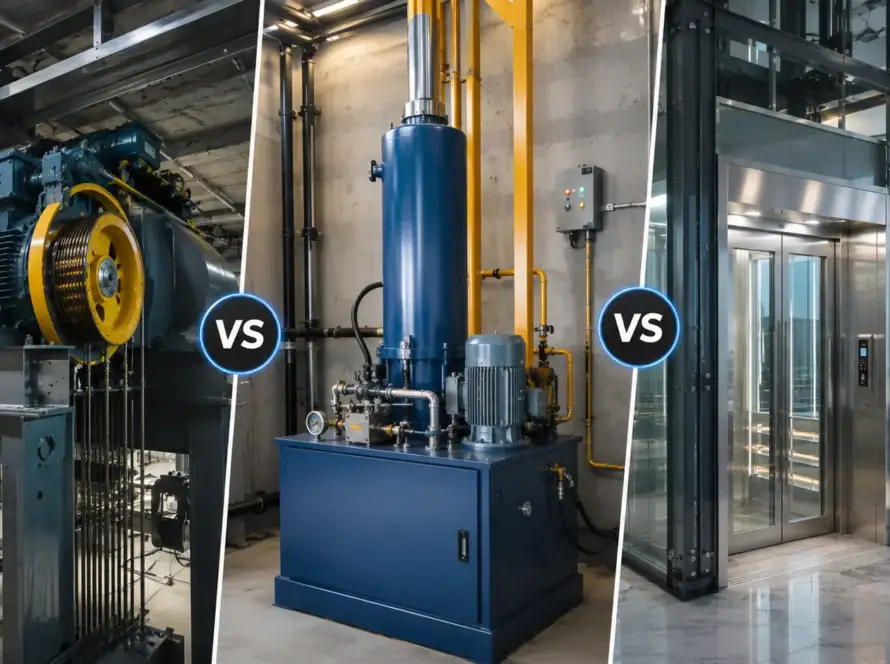
A conventional traction lift with a machine room on the terrace needs roughly 4.0 to 4.5 metres of vertical space from the topmost finished floor to the underside of the machine room ceiling. The machine room itself is a separate enclosure of roughly 2.0 to 2.5 metres in height. For most three-and-four-storey Lucknow homes with flat terraces, this is structurally available but architecturally inconvenient.
An MRL lift needs 2.6 to 2.8 metres of clear vertical space from the topmost finished floor to the underside of the shaft roof, with no separate machine room. The drive lives inside the shaft. For homes where the terrace cannot be broken or where the silhouette of the building must remain unbroken from the street, MRL is frequently the only viable answer.
A hydraulic lift, which pushes the cabin up from below using a piston, needs the least topmost clearance of all three — sometimes as little as 2.4 metres. The drive equipment lives in a small cabinet at the lowest landing.
The shaft also extends below the lowest landing, into what is called the pit. The pit holds the lift’s safety buffers and provides clearance for the cabin’s safety overrun in the downward direction.
Conventional traction and MRL lifts typically require 1.0 to 1.2 metres of pit depth. In Lucknow, this is a real number worth checking against the water table in the specific locality. In Indira Nagar, parts of Gomti Nagar phase 1, and the older neighbourhoods near the railway lines, the monsoon water table sits closer to the surface than a 1.2-metre pit can tolerate without a serious dewatering or pit-waterproofing plan.
For these sites, low-pit hydraulic configurations exist that operate on as little as 350 to 500 millimetres of pit depth. They are not the cheapest option, but they are the option that does not flood every July.
In new construction, the cleanest answer is to align the lift shaft with the staircase, sharing the building’s central vertical spine. The shaft becomes a fifth wall of the staircase block, the structural design accommodates both elements together, and the lift opens into the same landing the stairs open onto. This is the configuration we recommend for almost every new home we are involved in from the design stage.
In retrofits into existing homes, the answer depends on what the building offers. We have installed lifts in five recurring locations.
The first is the visual hollow inside the curve of a sweeping staircase. Many older Lucknow homes have a generous central staircase with usable space inside the curve. With careful structural planning, this space can be converted into a lift shaft without disturbing the staircase itself.
The second is a stacked column of utility rooms — broom cupboards, small bathrooms, store rooms — that align floor by floor. If the alignment exists, the column can be reorganised into a shaft. The functional loss is usually one storage closet per floor, traded for a working lift.
The third is an external shaft attached to the rear or side of the building. A steel-and-glass shaft is built outside the existing structure, with door openings cut into the exterior wall at each floor. This is the cleanest answer for homes where no internal space is available. The shaft is, in some cases, the most architecturally interesting addition to the house, designed in coordination with the homeowner’s architect.
The fourth is a balcony stack. Many Lucknow homes have small, underused balconies stacked above each other, often used only to hang one set of washing. If the balconies are structurally aligned, they can be enclosed and converted into a shaft.
The fifth, and the most surprising to homeowners, is the centre of a stairwell. In homes where the staircase wraps around a central void of roughly 1.0 by 1.0 metre, that void can sometimes house a compact home lift without the staircase itself being touched. The lift becomes the visual centre of the staircase rather than a separate object next to it.
The site visit takes ninety minutes. It measures three things in sequence. The usable footprint, against the three shaft sizes above. The structural feasibility, against the building’s existing load paths and the proposed location’s relationship to walls, columns, and beams. The route, meaning how the lift gets from the lowest landing to the topmost without intruding into a load-bearing wall, a critical column, or a primary plumbing stack.
The visit produces one of three answers, written on a single sheet of paper. Yes, here is the recommended location with rough dimensions and the system that fits it. Yes, here are two viable locations with the trade-offs of each. Or no, and here is exactly why — usually a structural constraint that cannot be reasonably worked around.
Most of the time, the answer is yes. The house was usually trying to tell us. The owner had simply been looking at it through a footprint that no longer applied.