

A villa, in the way the word is used in Lucknow, is a single-family home that has been designed with more attention than the standard plot allows for. It usually sits on between 200 and 600 square yards. It usually has three or four floors above ground, sometimes with a basement. It is usually owned, not rented. It is usually the most considered building the family will ever live in. And it is, almost without exception, designed around the daily routine of a single household — the lift inside it has to behave the same way.
A villa lift is not a small apartment-building lift. It is a different brief altogether, and the difference is worth understanding before the cabin gets ordered.
An apartment lift in a fifty-unit building runs three hundred to six hundred trips a day. Most trips are short. Most riders do not know each other. The lift is calibrated for throughput and anonymity.
A villa lift in a four-floor home runs between fifteen and seventy trips a day, depending on the family. The first and last trips of the day are usually the household’s elders. The middle of the day is mostly help — the cook bringing groceries up, the housekeeping moving laundry between floors, sometimes a delivery being received. Evening is the children. Late evening is the working parents.
This pattern has implications. The lift cannot be a piece of public infrastructure that the household interacts with formally. It has to feel like part of the house. The cabin opens onto living spaces, not onto lobbies. The cabin will sometimes be entered by a barefoot child. It will sometimes carry a pet. It will sometimes carry a pot of food directly from the kitchen to the dining floor without a tray. The materials, the lighting, the door behaviour, all have to assume this familiarity rather than fight it.
A villa lift has to be quiet. Not “quiet” in the marketing sense — quiet in the specific sense that the cabin moving past a bedroom on its way to the floor above does not wake the person sleeping in that bedroom. For a residential MRL with a permanent-magnet gearless drive, this is achievable with appropriate cabin isolation and shaft acoustic treatment. For an older geared traction lift, it is not.
It has to be smooth. Smoothness is two measured quantities: vibration during travel, in milli-g, and jerk at start and stop, in metres per second cubed. A villa lift that meets the household’s expectation typically delivers vibration below 15 milli-g during travel and jerk below 1.0 metre per second cubed at deceleration. These are values a well-tuned modern MRL or hydraulic lift can reliably deliver. They are not values a budget commercial-grade installation can deliver, regardless of what the catalogue says.
It has to be visually integrated. The cabin is a small room that opens into the rest of the house. The materials of the cabin floor, walls, and ceiling have to be specified alongside the materials of the floors and walls they open onto. If the rest of the house is in oak and brushed brass, the cabin in standard stainless steel will look like a foreign object every day for the next thirty years.
It has to be compact in headroom and pit. Villas in Lucknow rarely have unlimited terrace clearance, and almost none have a basement deep enough to accommodate a generous lift pit. The villa lift has to fit inside the structural envelope the architect has already designed, which usually means MRL with 2.6 metres of topmost headroom and 1.0 metre of pit, or a hydraulic configuration with even smaller numbers.
It has to be reliable to a higher standard than a commercial lift. This is the element most often misunderstood. A commercial building with twenty lifts can absorb the failure of one. A villa has exactly one lift. Its failure is, in practice, the failure of vertical mobility in the entire building. The specification has to be designed around the fact that there is no redundancy. The AMC has to be priced and structured around the fact that downtime is total.
The cabin is the only part of the lift the household experiences. Everything else is engineering that should remain invisible. The cabin specification deserves disproportionate attention.
The floor is the most neglected element. Stainless steel chequer plate, which is the default in commercial cabins, is the wrong specification for a villa. It is loud underfoot, cold to bare feet, and visually unrelated to the floors it opens onto. The right specifications are matched to the surrounding floor materials: stone for stone-floored homes, engineered wood for wood-floored ones, matt-finish ceramic tile for tiled ones. The cabin floor should feel like a continuation of the landing.
The walls deserve the same logic. The standard catalogue stainless steel cabin walls are functional. They are also aggressively un-residential. Veneer panels in oak or walnut, leather-clad panels in a single tone, brushed-metal panels in champagne gold or bronze, glass panels onto a designed shaft — these are the materials that turn the cabin into a room. They cost meaningfully more. They also age into the home rather than out of it.
The lighting is the third element. Cabin lighting in standard installations tends toward cool white LED panels in the ceiling. Cool white is cheap, efficient, and not flattering to the cabin or the person inside it. Warm white, indirect, in a coved or recessed configuration, with the colour temperature matched to the rest of the home’s lighting, is a small specification change that produces a disproportionate experience difference. The household notices it within a week and does not notice it again for thirty years, which is exactly the kind of decision that pays off.
Door type is more important in a villa than in a commercial building. Automatic centre-opening doors are the safest, most child-resistant, and most accessibility-friendly. They are also the largest, and they consume more wall area at each landing.
Telescopic side-opening doors take less width and may be the right answer when the landing wall is constrained. Manually operated swing doors with an internal collapsible gate, which used to be the residential default twenty years ago, are still permitted and still installed in some homes for aesthetic reasons, but we generally do not recommend them: they are noisier, require active operation by the user, and do not provide the safety interlocks a modern accessibility-friendly home should standardise on.
Door speed is a small specification with a noticeable effect. A door that opens in 1.8 seconds rather than 2.6 saves the household, in aggregate, several minutes a week of standing in front of a lift. Over thirty years of use, the household will not consciously thank us for the difference. They will simply find that using the lift is a slightly more pleasant experience than they remember it being in other homes.
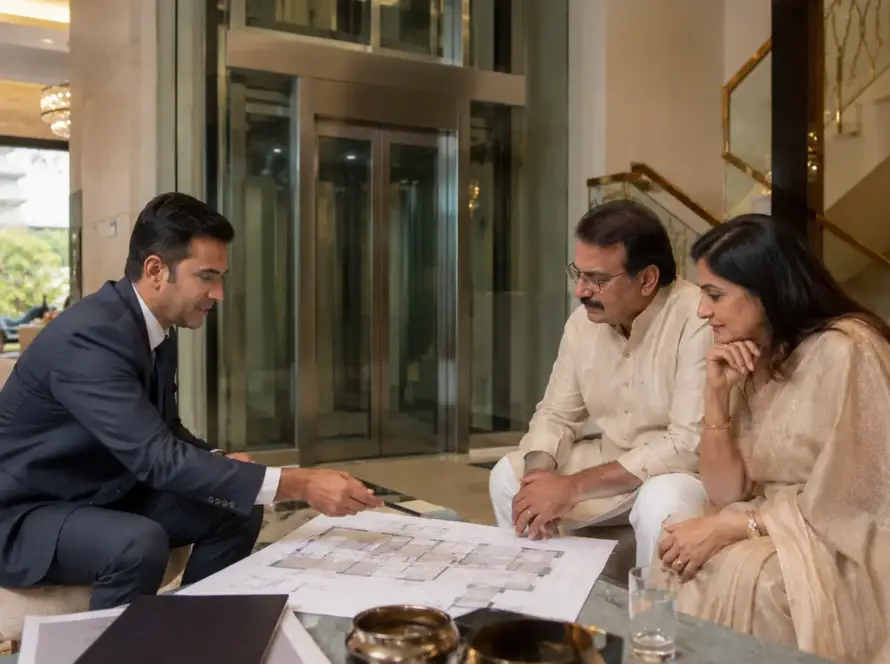
The villa lift is one of the few elements of the building that touches structure, MEP, façade, interior design, and household operations at once. The conversation about it has to happen with the architect in the room, not after the architect has finished drawing.
For new construction, we ask to be in the second design-development meeting. By that point the architect has the rough room layouts and the rough structural grid; the lift’s location and specification can be decided alongside both. Decisions made at this stage cost nothing to change. The same decisions made after the slabs are poured cost real money to undo.
For retrofits, the conversation is sharper but the principle is the same. The lift has to be designed against the existing building, with the architect’s involvement, with the homeowner present, and with a single sheet of paper at the end summarising what will happen, when, and what the household will experience during installation. We do not begin work without this sheet.
If your villa is at the design stage, the most useful next step is to bring us into the architect’s review meeting. We do not charge for the consult. We do not push specifications the home does not need. We will tell you, in writing, whether what the architect has drawn for the lift will produce the experience the household actually wants — and if not, what to change.
If your villa is built and the lift is being added now, the site visit is the right starting point. The conversation after the visit is calmer and more useful than the catalogue conversation that usually precedes it.