

Lucknow has been a horizontal city for most of its history. The havelis of the old city spread sideways around courtyards. The colonial buildings of Hazratganj and Civil Lines stretched along the street rather than upward into the sky. The post-independence colonies — Aliganj, Indira Nagar, Mahanagar, the early sections of Gomti Nagar — were laid out on rectangular plots designed for two-storey homes and generous setbacks.
The city has begun, in the last fifteen years, to grow upward. The shift is not a real-estate fashion. It is a response to four specific structural changes in how the city’s families live and how its commerce operates. This piece walks through those four changes, what they mean for vertical mobility infrastructure in the city, and why the lift conversation in Lucknow has, in the last few years, moved from the rare to the routine.
For a long generation, the Lucknow family upgrading its home upgraded by moving to a larger plot. From the 100-yard plot to the 200-yard plot to the 400-yard plot, the household’s increased size or aspiration expressed itself horizontally. Land was available, the city’s expansion outward was steady, and the plot was the obvious dimension of growth.
That trajectory has slowed materially. The plot prices in the established Lucknow neighbourhoods — Gomti Nagar phase 1 and 2, Mahanagar, Aliganj, Indira Nagar — have risen to the point where the upgrade from a 200-yard plot to a 400-yard plot in the same locality is, for many families, no longer a comfortable jump. The newer expansion areas — Vrindavan, Sushant Golf City, the trans-Gomti developments beyond ring road — offer larger plots but at the cost of a longer commute and a less established neighbourhood.
The household’s natural response, when horizontal expansion becomes difficult, is vertical expansion. The 200-yard plot that previously held a two-storey home now holds a three-or-four-storey home. The floor count has crept upward across the city’s residential fabric over the last decade in a way that is obvious to anyone walking through any established neighbourhood. The growth is not in glamorous high-rises; it is in the quiet third and fourth floors that have been added, room by room, to the homes that were originally built as two.
Four storeys is the height at which a staircase becomes a daily limitation. Three storeys is the height at which it becomes a daily mild inconvenience that gradually compounds. The city’s housing stock has moved into the band where the lift conversation is no longer rare.
The narrative of the Indian urban family during the 1990s and 2000s was one of fragmentation. Nuclear units moving to smaller apartments. The parental home in the home town being visited rather than inhabited. The joint family being described, in academic and popular writing alike, as a structure that the modern Indian household was leaving behind.
The 2010s and 2020s have, in Lucknow at least, run partly in the opposite direction. The economics of two parents and two children in a 1500-square-foot apartment, in a city where the same family could occupy a 4000-square-foot multi-floor home for a comparable monthly cost, has reasserted itself. The post-pandemic relocations of working professionals back to their home cities accelerated the trend. The home in Lucknow that the family had been describing as the “parents’ house” became, for many households, the main residence again.
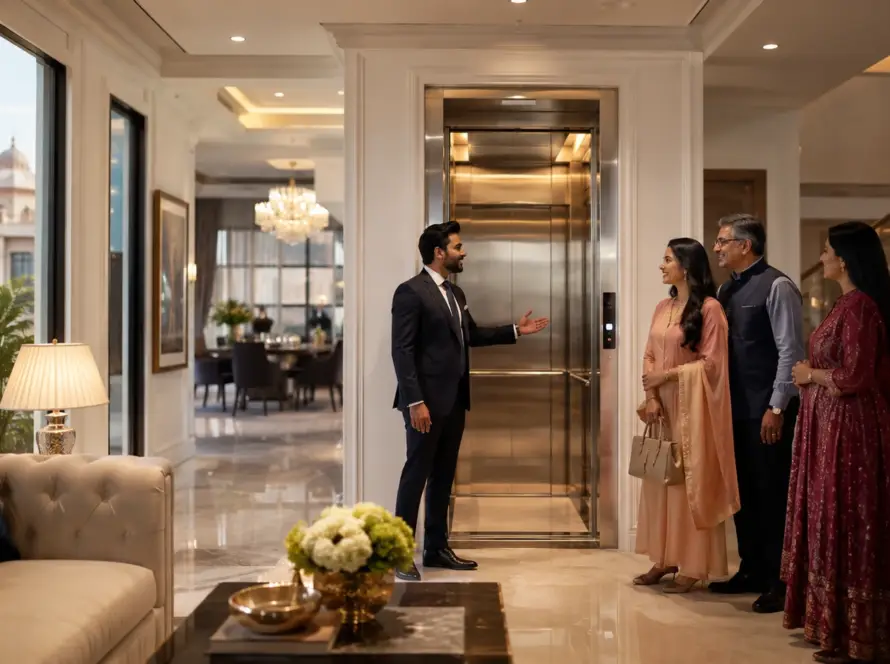
The multi-floor home that worked for the original family of four now houses, in many cases, the original parents plus the returned children plus the grandchildren. Three generations occupy the building. The grandparents are typically in their seventies; the children are in their thirties and forties; the grandchildren are in primary school. The staircase, which the original family had treated as routine, is now being negotiated by people across a much wider physical range.
This is the demographic that the residential lift category is being built for. It is also the demographic that did not exist, in this concentration, in Lucknow’s residential market twenty years ago.
Lucknow’s commercial development has not produced the high-rise office skyline that cities like Gurgaon or Hyderabad are known for. What it has produced is a specific category of building that the city’s economy is increasingly built around: the four-to-eight-storey mixed-use commercial building, with retail at street level, offices on the middle floors, and sometimes residential or hospitality at the top.
These buildings are concentrated along Lucknow’s commercial corridors — Vipul Khand, Vipin Khand, the Faizabad Road corridor, Gomti Nagar Extension’s commercial bands, the Sushant Golf City road, the older established stretches of Hazratganj and Aminabad that have rebuilt vertically. Each of these buildings requires multiple lifts. The lifts are no longer the simple geared traction units of the previous generation; they are MRL and capsule installations that have to handle commercial traffic, accept a designed cabin specification, and meet the modern safety and accessibility standards the city’s commercial tenants increasingly expect.
The four-to-eight-storey commercial band is, in lift industry terms, the most demanding sweet spot. Lifts in this band serve serious traffic without being able to amortise across the dozens of cabins that an actual high-rise can. Each lift has to be specified properly, installed properly, and maintained properly, because there is no redundancy elsewhere in the building to absorb a failure.
Lucknow’s hospital sector has gone from a handful of large institutions a generation ago to a developed ecosystem of mid-sized and large hospitals across the city. Each of these institutions runs on multiple specialised lifts: stretcher lifts that meet hospital-grade specifications, separate goods lifts for medical waste and supplies, passenger lifts for visitors and staff. The category of “hospital lift” is no longer a few installations a year for the city; it is a continuous category of specification, installation, and modernization work.
Hospitality has followed a parallel trajectory. The mid-and-upper-segment hotels that have opened in Lucknow in the last decade — across Hazratganj, Gomti Nagar, the airport corridor, and along the highway exits — require capsule lifts, designed cabin interiors, premium maintenance contracts, and the kind of service relationships that older Lucknow lift providers were not structured to deliver.
These two sectors have, between them, raised the floor of what “a serious lift partner in Lucknow” has to be capable of. The standard is higher than it was. The expectations on response times, on documentation, on engineering depth, on aesthetic capability, are all measurably higher than they were ten years ago. The buildings that are being designed today are designed against this raised floor; the buildings that were designed against the older floor are now coming back for modernization.
The cumulative effect of these four shifts is that Lucknow’s relationship with vertical mobility is, in the present moment, in active transition. The city is growing upward in a way that requires a different category of lift conversation than it did a decade ago.
The residential category is the largest single beneficiary, because the joint family in a four-storey home is the most common case in our installation pipeline. The commercial mid-rise category is the most demanding, because these are the buildings where lift specification has to be done properly the first time. The hospital and hospitality categories are the most specialised, because the engineering and service requirements are tighter than any other category.
Across all four, the working principle is the same. The city has moved past the era in which the lift was a piece of equipment that someone else’s building had. The lift is, now, infrastructure that the city’s buildings — including the buildings that the city’s families live in — are being designed around.
For households planning a new home, the lift now belongs in the architect’s earliest schematic conversation, not bolted on later. For households living in an older home, the retrofit conversation is more often a “yes, here is where it fits” than the “this building cannot accept a lift” of a decade ago. For commercial owners, the standard of what a lift partner has to deliver has risen in step with the standard of what tenants expect. For hospitals and hotels, the lift is part of the building’s clinical or hospitality experience, not an accessory to it.
The city is going vertical at a pace that is easy to underestimate because it is happening building by building rather than skyline-by-skyline. Watching it happen, across the close to a thousand installations we have served across Uttar Pradesh, the most consistent observation is this: the families and the buildings that have planned for vertical mobility ahead of their need have, almost without exception, found the planning worth it. The ones that waited are, almost without exception, doing the same conversation now under more pressured conditions.
The right time to have the conversation, in this city, in this decade, is before the building or the household needs it to be done.